This thread has been locked.

If you have a related question, please click the "Ask a related question" button in the top right corner. The newly created question will be automatically linked to this question.

LMX2594: TICS Pro: optimum settings to reduce spurs

Genius 12865 points

Part Number: LMX2594

Hello Team,

In fractional mode, TICS pro offers me different possibilities to achieve a certain frequency.
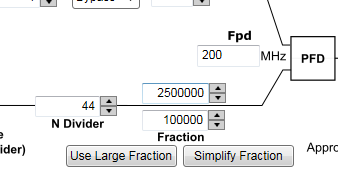
  

I can increment the N Divider to increment my VCO frequency by Fpd or I can increment the nominator of the fraction by the value of the denominator to get the same resulting VCO frequency.

So for easier software programming, I could fix the N Divider at the lowest frequency that I want to achieve and reach all frequencies above by just incrementing the nominator. The denominator would stay fixed to determine the frequency resolution.

Does this approach have any drawbacks, e.g. regarding spur perfomance?
So is there a value range that the fraction should stay within?

Thanks and Best Regards,

Hans

  • Hans,

    This is an intriquing concept, but we have never tried it.  If you have our EVM or an actual device to try it on, then it should work, but this would require some measurements.  It might work fine, but as we never intended to have the part used in this manner, I would be cautious and ensure that there are now drawbacks.

    Here are some of my thoughts on this...

    1.  We have not characterized the part this way and we do not test the device in production this way.  So although this seems like a feasible thing to do, we don't know if doing this will bring any unexpected surprises.

    2.  If the N divider is too low, then fractional spurs are slightly higher.  In this case, maybe 44 is large enough, but for low N divider values, the N divider causes an ununiform MASH clock that can lead to higher spurs.  So I would say if N>40, you probably won't see this.

    3.  If you do use this method, then reduce the denominator size if it is unnecessarily large.  I say this because:

    a.   This allows you to hit higher N divider values

    b.   If the goal is simplification of programming, if you can get it to one write of the fractional numerator, that would simplify it.

    c.  If you use large equivalent fractions like  1000000/5000000  (equivalent to 1/5), then if you get a nonzero seed value then it can make noise.  I don't think that this would happen, but since you are rolling the fractional numerator , maybe ( I don't know) it could happen.

    4.  If you are only intending to do  this for integer mode values, then I would use the 1st order modulator.  This gets less fractional circuitry involved.

    5.   Ensure that this does not confuse the VCO calibration.

    The VCO calibration is based on the N divider value.  If you have not actually tried this, ensure that the VCO calibrates to the correct frequnency and it does not truncate this fraction.  If you make it go more than 400 MHz away from the frequency that it would be if the fraction was rounded to 1/1, then this would be a good way to confirm.

    Regards,
    Dean

  • Hi Dean,

    thanks for these details, but maybe I should ask differently:

    As Fvco = (N +m/n) x Fpd I just wanted to get some guidance on how to set any wanted output-frequency. Should m/n always be <1 to get minimum number of spurs?

    TICSPro allows also m/n to be >1.

    Example: What is the difference between Fvco = (20 + 4/3)xFpd and Fvso = (21 + 1/3)xFpd in terms of spurs?

    Thanks and Best Regards,

    Hans

  • Hans,

    The setting  m>=n was not intended when the circuit was designed, characterized, or curreltly production tested for.  In other words, if you try this and it causes issues in production, do not expect TI is take responsibilty for this.

    However, from  a theoretical perspective, I would expect it to be the same or worse.   The reason is that the N divider output to the phase detector is being modulated.  For lower N divider values, this modulation is more and this uneveness creates lower frequency spurs to be greatly increased.   So from this perspective, it is worse.  I have no data to prove or disprove this theory though.

    Regards,
    Dean