Other Parts Discussed in Thread: HALCOGEN
I WANT TO USE PWM IN MY PROJECT FOR QUARATURE PULSE GENERATOR FOR PULSE PURPOSE HOW DO THAT , IAM USING EXAMPLE CODE OF TMS570LS4357 EQAP , HOW TO INCLUDE PWM IN OUR PROJECT WHAT WILL BE SET UP AND CODE
This thread has been locked.
If you have a related question, please click the "Ask a related question" button in the top right corner. The newly created question will be automatically linked to this question.
Other Parts Discussed in Thread: HALCOGEN
I WANT TO USE PWM IN MY PROJECT FOR QUARATURE PULSE GENERATOR FOR PULSE PURPOSE HOW DO THAT , IAM USING EXAMPLE CODE OF TMS570LS4357 EQAP , HOW TO INCLUDE PWM IN OUR PROJECT WHAT WILL BE SET UP AND CODE
Hello jeev,
Our expert for this topic is out on local holiday and will be back on Wednesday, please wait for their feedback until then, thank you.
Best Regards,
Ralph Jacobi
Hi Jeev,
The PWM can be generated in two ways. One way is using ETPWM and the other way is using NHET.
Using ETPWM:
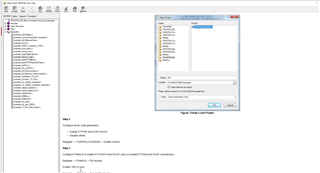
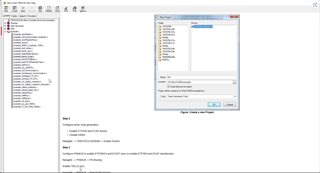
To learn this, refer the example codes present in the Help Topics section of HALCoGen

Using NHET:
In this method we have to use a special IDE called HET IDE.
HET IDE User guide spnu483a.pdf
Refer below threads also:
--
Thanks & regards,
Jagadish.
what u send image its not supporting ,can u send in jpg form, bro i have example code quarature pulse encode for that input as pulse through PWM , how to include both example code
Hi Jeev,
what u send image its not supporting ,can u send in jpg

--
Thanks & regards,
Jagadish.
Hi Jeev,
i have example code quarature pulse encode for that input as pulse through PWM , how to include both example code
Combining two codes is easy, you can do something like below:
#include "sys_common.h"
/* USER CODE BEGIN (1) */
#include "eqep.h"
#include "sys_core.h"
#include "HL_etpwm.h"
#include "HL_adc.h"
/* USER CODE END */
/* USER CODE BEGIN (2) */
#define UNIT_POSITION_X 60U
uint8 emacAddress[6U] = {0xFFU, 0xFFU, 0xFFU, 0xFFU, 0xFFU, 0xFFU};
uint32 emacPhyAddress = 1U;
/* USER CODE END */
void main(void)
{
/* USER CODE BEGIN (3) */
uint16 deltaT = 0U;
float velocity = 0U;
_enable_interrupt_();
adcInit();
etpwmInit();
/* EQEP initialization based on GUI Configuration. */
QEPInit();
/* Enable Position Counter */
eqepEnableCounter(eqepREG1);
/* Enable Unit Timer. */
eqepEnableUnitTimer(eqepREG1);
/* Enable capture timer and capture period latch. */
eqepEnableCapture(eqepREG1);
adcEnableNotification(adcREG1, adcGROUP0);
adcStartConversion(adcREG1, adcGROUP0);
while(1)
{
/* Status flag is set to indicate that a new value is latched in the QCPRD register. */
if((eqepREG1->QEPSTS & 0x80U) !=0U)
{
/* Elapsed time between unit position events */
deltaT = eqepREG1->QCPRD;
/* Calculate Velocity from deltaT and the value of the unit position. */
/* The value of Unit Position is a sample value and should be changed by the User as per the actual value in the UNIT_POSITION_X macro above. */
velocity = (float)(UNIT_POSITION_X/deltaT);
/* Clear the Status flag. */
eqepREG1->QEPSTS |= 0x80U;
}
}
void adcNotification(adcBASE_t *adc, uint32 group)
{
adcData_t data;
uint32 count;
uint16 cmpA;
count = adcGetData(adcREG1, adcGROUP0, &data);
cmpA = (etpwmREG1->TBPRD * data.value)/0xFFF;
etpwmSetCmpA(etpwmREG1, cmpA);
}
/* USER CODE END */
}
But the problem is you have to do the proper configurations in HALCoGen right? otherwise the code won't work properly. So please make sure to do proper HALCoGen configurations as well.
--
Thanks & regards,
Jagadish.