This thread has been locked.

If you have a related question, please click the "Ask a related question" button in the top right corner. The newly created question will be automatically linked to this question.

LMH0302: Architecture for improving HD-SDI signal rise/fall times and IC reference

Part Number: LMH0302
Other Parts Discussed in Thread: LMH0397

Hello,

we have a military application where the HD-SDI signal rise and fall time do not meet SMPE292M. We have no jitter issues. We are looking to design a PCB to improve rise/fall time. Now according to litterature, we have 2 ways to "reshape" the signal: Recloking or Equalizing (or both?). We won't have FPGAs or uCs on board, we are trying to keep this as basic as possible. Looking thru Texas datasheets, there are numerous P/N potentially suited for the job. Do you have an architecture to suggest (Recloking and/or Equalizing?) and couls you point us to relevant IC reference, App notes? Thx

Serge

  • Hi Serge,

    Consider LMH0302 for SMPTE292M. This has a programmable output slew rate control that should fix your rise/fall times. 

    Are you driving from a differential pair into BNC? The LMH0302 is made for this sort of application, but I can look for alternatives depending on the system need.

    Best,

    Shane

  • Hello Shane,

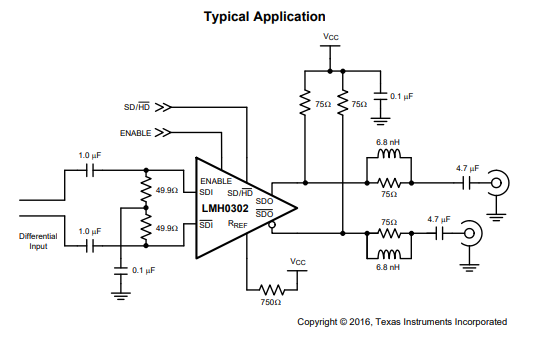
    and thx for your answer. No, we have a single SDI coax, no /SDI. Same for output, we need SDO no /SDO. So, I was planning on connecting /SDI to something like that:

    Any thought on that? Also, what should I terminate /SDO pin with?

    Thx

    Serge

  • Hi Serge,

    That implementation would likely not work with LMH0302 due to it expecting 50 ohm inputs. It seems you're going from a single 75-ohm receiver to a single 75-ohm output (correct me if I'm wrong). We have LMH0397 that can accomplish this:

    This device supports SMPTE292 so it should work for the application. Please note I'll be out of office after today until Wednesday of next week, so someone on my team may follow up on this thread.

    Best,

    Shane

  • Hello Shane,

    We indeed have a 75Ohm single ended input and we want a single ended SDO 75Ohms output. Using LMH0397, what terminations do we have to apply to unused OUT0+,OUT0- and IN0+,IN0-?

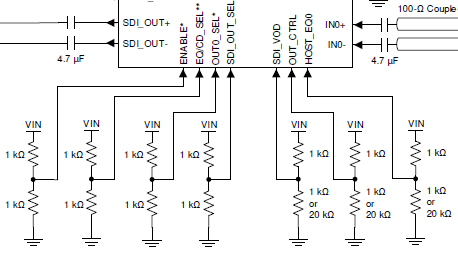
    We are not planning on using any uController so we won't be able to write to registers in SPI or I2C  mode. Can you confirm using external pullups or pulldowns is sufficient to configure the device and ensure operation:

    Finally, since we simply want to improve the rise time of the input eye diagram (no jitter to speak of) can you confirm this mode of operation is the proper one:

    "Normal Operation,SDI_IO cable equalizer enabled, Reclocker enabled" (EQ/CD_SEL=Low and OUT_CTRL=F)?

    Thx

  • Hi Serge,

    Using LMH0397, what terminations do we have to apply to unused OUT0+,OUT0- and IN0+,IN0-?

    You can leave these pins floating similar to this E2E, though I would recommend placing resistor options to terminate each of these pins to GND with 50 ohms as a precaution.

    Can you confirm using external pullups or pulldowns is sufficient to configure the device and ensure operation:

    Yes, you can configure the device through resistor strapping. Register access is optional.

    can you confirm this mode of operation is the proper one:

    You would need to use EQ mode to take data from the SDI_IO to SDI_OUT pin(s):

    Additionally you need to enable the line-side loop through output by setting SDI_OUT_SEL low:

    For OUT_CTRL, the floating setting (F) is what I would recommend to start. This enables the cable equalizer and the reclocker on the device. As a precaution I also recommend leaving options to pull this pin high or low via resistors if needed.

    Best,

    Shane

  • Hello Shane Slight smile

    and thx for your invaluable support, you answered all my questions. Might as well change this thread name to LMH0397!

    Serge