This thread has been locked.

If you have a related question, please click the "Ask a related question" button in the top right corner. The newly created question will be automatically linked to this question.

MSPM0G1519: MSPM0G3507-Q1: instantaneous current limited on GPIO (Standard GPIO)

Part Number: MSPM0G1519

Similar to the two questions here: 

https://e2e.ti.com/support/microcontrollers/arm-based-microcontrollers-group/arm-based-microcontrollers/f/arm-based-microcontrollers-forum/1194792/mspm0l1304-driving-resistive-capacitive-loads-with-digital-outputs 

and 

https://e2e.ti.com/support/microcontrollers/arm-based-microcontrollers-group/arm-based-microcontrollers/f/arm-based-microcontrollers-forum/1601579/mspm0g3507-q1-instantaneous-current-limited-on-gpio-spi/6187439


I'm looking at powering an on board accelerometer which has a nominal current draw of 64uA with a GPIO pin. The purpose of powering this accelerometer from a GPIO pin directly is to minimize cost and complexity of adding another component, while maintaining the ability to perform a hard reset on the power to the device.  
The 64uA shouldnt be an issue for the GPIO pin, however the on board accelerometer datasheet reccomends a 10uF capacitor on the power line. 
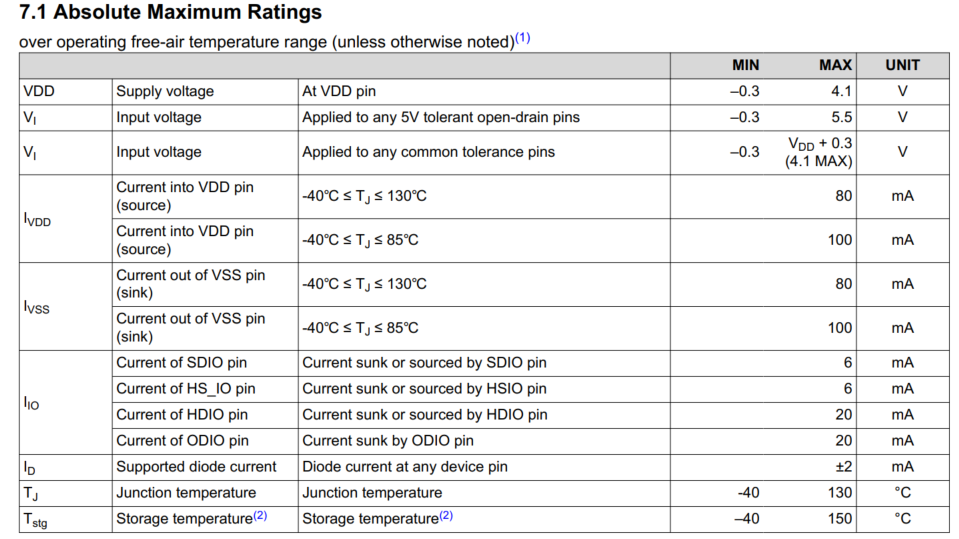
image.png

The 10uF capacitor drives the inrush current well above the 6mA maximum for an SDIO pin. 
Is this a concern for the uC pin that will cause damage? 

  • Put a resistor in series to limit the inrush.

  • What should the target current limit be for designing that resistor? Does it need to be 6mA, or is that a continuous rating, does the micro have any protections in place? A resistor will limit the voltage available at the on board accelerometer. 

  • I doubt that you will get an answer from TI, since it is a complex interaction between the resistance's, capacitance's and drain resistance of the PMOS. The spec calls out a max drop of 0.4 V at 6mA, which says that the drain resistance can be as high as 66 ohms.

  • Hi Stephan, I agree with Keith that this involves a lot of interactions and complexity, but a few things you could try:

    • Add a Series Resistor: Place a to resistor in series with the line connecting the microcontroller pin to the capacitor (maybe 100Ω - 300Ω). This limits the peak current which is much closer to a survivable level, and the time constant is short enough for fast switching. (As Keith mentioned below)
    • Use a Dedicated Load Switch: Use a small, low-current load switch (like a TI TPS229xx) to turn on the power to the accelerometer. This provides controlled turn-on (slew rate control) and avoids inrush on the I/O lines entirely.
    • Reduce Capacitance: If possible, reduce the 10µF capacitor to a smaller value (e.g., 1µF or 4.7µF), though this may not be possible if you start seeing the accelerometer not working as intended.