This thread has been locked.

If you have a related question, please click the "Ask a related question" button in the top right corner. The newly created question will be automatically linked to this question.

AM2432: PRU Firmware loading will clear the register of TXCFG0_TX_CLK_DELAY

Part Number: AM2432

Hi team

Follow up the issue from Top customer. Customer need to achieve the txclk and data signal at different sequency. So we provide a way via configuring the register. However the register will be clear after the PRU firmware loaded. 

The ECAT PRU firmware is based on SDK version ind_comms_sdk_am243x_2025_00_00_08.

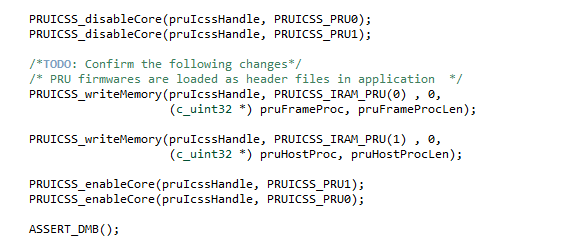
Writing the TXCFG0_TX_CLK_DELAY value before the following PRU firmware load function works, but this value is cleared to 0 after the PRU firmware loads.
7654321.png

It requires writing to register bits 28-31 again after a delay of approximately 2 seconds after the PRU firmware loads for the write to succeed.

Customer need to speed up the boot time and avoid this 2 seconds delay.  

Any good ideas about this?

Thanks

Zekun

  • This is from  the original issue reply.

  • Hi Zekun,

    Please expect a response by tomorrow (due to regional holiday).

    Regards,
    Aaron

  • Hi Zekun,

    The EtherCAT PRU firmware rewrites the full MII_RT_TXCFG0/1 registers — including bits 30:28 (TX_CLK_DELAY) — every time a port state change is detected. This happens repeatedly during firmware initialization as the port scanning loop runs, which is why any pre-load write gets overwritten and a post-load write only "sticks" once the firmware has settled.

    Recommended Solution (no firmware change):

    Set the TX_CLK_DELAY bits inside the TI_VS_PORT0_TX_START_DELAY shared RAM parameter before enabling the PRU cores. The SDK populates this parameter during EtherCAT stack initialization. Include the desired TX_CLK_DELAY value in bits 14:12 of both the FWD and REV TX_START_DELAY 16-bit words:

    bsp_init() writes the TX start delay to PRUSS Data RAM at ESC_ADDR_TI_PROCESS_PATH_TX_START_DELAY (offset 0xE10) before the PRU firmware is loaded. When the PRU firmware starts, it reads this word from DRAM and writes it to the MII_RT_TXCFG hardware register.

    Because the stored word only encoded TX_START_DELAY (bits 9–0) and left bits 14–12 as zero, the PRU firmware always write TX_CLK_DELAY=0, overwriting any value written directly to the hardware register before the PRU started.

    By encoding TX_CLK_DELAY in bits [14:12] of the value written to DRAM[0xE10-0xE11], the PRU firmware will automatically preserve the correct TX_CLK_DELAY setting every time it initializes the MII_RT_TXCFG register. No post-load write and no 2-second delay are needed.

    Background

    The 16-bit word written to ESC_ADDR_TI_PROCESS_PATH_TX_START_DELAY (PRUSS DRAM offset 0xE10) maps directly to bits [31:16] of the MII_RT_TXCFG hardware register. Two independently configurable fields are packed into this word:

      Address   Byte     Bits      MII_RT_TXCFG field
      --------  -------  --------  ---------------------------
      0xE10     low      [7:0]     TX_START_DELAY[7:0]
      0xE11     high     [6:4]     TX_CLK_DELAY   (3-bit, 0–7)
                         [1:0]     TX_START_DELAY[9:8]  (always 0 for current values)
    

    Previously these were written together as a single bsp_write_word. The change splits them into two bsp_write_byte calls so each field is configured and understood independently.

    Changes to tiescbsp.h

    Added — new TIESC_TX_CLK_DELAY_BYTE helper and user knob:
    
    /*
     * TX_CLK_DELAY high-byte value for ESC_ADDR_TI_*_TX_START_DELAY + 1.
     * Bits [6:4] of the high byte map to TX_CLK_DELAY bits [30:28] in MII_RT_TXCFG.
     * Adds (n*5 + 10) ns + SOC delay per step (n = 0..7).
     * NOTE: Per TRM, keep at 0h (default) for guaranteed MII_G_RT I/O timing
     * at 200/225/250 MHz core clock.
     */
    #define TIESC_TX_CLK_DELAY_BYTE(n)    ((uint8_t)((n) << 4U))
    
    /* TX_CLK_DELAY for process (forward) path: 0 = default; set to 1-7 to add MII launch delay */
    #define TIESC_PROCESS_PATH_TX_CLK_DELAY    3U
    Unchanged — existing TX_START_DELAY macros (now used as the low byte):
    
    #if ENABLE_MULTIPLE_SM_ACCESS_IN_SINGLE_DATAGRAM
    #define TIESC_PROCESS_PATH_TX_DELAY_200_MHZ_CLOCK    0x98
    #else
    #define TIESC_PROCESS_PATH_TX_DELAY_200_MHZ_CLOCK    0x48
    #endif
    #define TIESC_AUTOFORWARD_PATH_TX_DELAY_200_MHZ_CLOCK    0x38
    
    #if ENABLE_MULTIPLE_SM_ACCESS_IN_SINGLE_DATAGRAM
    #define TIESC_PROCESS_PATH_TX_DELAY_333_MHZ_CLOCK    0xA0
    #else
    #define TIESC_PROCESS_PATH_TX_DELAY_333_MHZ_CLOCK    0x50
    #endif
    #define TIESC_AUTOFORWARD_PATH_TX_DELAY_333_MHZ_CLOCK    0x30


    Changes to tiescbsp.c

    Before (single 16-bit write, TX_CLK_DELAY was always 0):
    
    bsp_write_word(pruIcssHandle, TIESC_PROCESS_PATH_TX_DELAY_200_MHZ_CLOCK,
                ESC_ADDR_TI_PROCESS_PATH_TX_START_DELAY);
    bsp_write_word(pruIcssHandle, TIESC_AUTOFORWARD_PATH_TX_DELAY_200_MHZ_CLOCK,
                ESC_ADDR_TI_AUTOFORWARD_PATH_TX_START_DELAY);
    After (two separate byte writes for process path):
    
    /* Process (forward) path TX_START_DELAY: low byte of the 16-bit word at
     * ESC_ADDR_TI_PROCESS_PATH_TX_START_DELAY. Maps to MII_RT_TXCFG bits[23:16].
     * Controls the number of MII_RT clock cycles after RXDV before TX starts. */
    bsp_write_byte(pruIcssHandle, TIESC_PROCESS_PATH_TX_DELAY_200_MHZ_CLOCK,
                ESC_ADDR_TI_PROCESS_PATH_TX_START_DELAY);
    
    /* Process (forward) path TX_CLK_DELAY: high byte of the same 16-bit word.
     * Bits[6:4] map to MII_RT_TXCFG bits[30:28]. Controls the number of
     * MII_RT clock cycles to wait before launching TX data on the MII interface.
     * Configured separately so TX_START_DELAY and TX_CLK_DELAY can be tuned
     * independently. Set TIESC_PROCESS_PATH_TX_CLK_DELAY (0-7) in tiescbsp.h. */
    bsp_write_byte(pruIcssHandle, TIESC_TX_CLK_DELAY_BYTE(TIESC_PROCESS_PATH_TX_CLK_DELAY),
                ESC_ADDR_TI_PROCESS_PATH_TX_START_DELAY + 1U);
    
    /* Autoforward path TX_START_DELAY: written as a single 16-bit word.
     * TX_CLK_DELAY is not configured for the autoforward path (kept at 0). */
    bsp_write_word(pruIcssHandle, TIESC_AUTOFORWARD_PATH_TX_DELAY_200_MHZ_CLOCK,
                ESC_ADDR_TI_AUTOFORWARD_PATH_TX_START_DELAY);
    The same pattern applies for the 333 MHz branch.

    How to Configure TX_CLK_DELAY

    Change only this one line in tiescbsp.h:

    #define TIESC_PROCESS_PATH_TX_CLK_DELAY    3U   /* 0 = default; 1–7 = additional delay */
    
    Value High byte written to 0xE11 Additional MII launch delay
    0 0x00 0 ns — TRM default
    1 0x10 ~5–10 ns + SOC delay
    2 0x20 ~10–15 ns + SOC delay
    3 0x30 ~15–20 ns + SOC delay ← current setting

    The auto-forward path is intentionally kept as bsp_write_word with no TX_CLK_DELAY component (the auto-forward path has tighter latency requirements).


    Files Changed Summary

    File Change
    tiescbsp.h Added TIESC_TX_CLK_DELAY_BYTE(n) helper macro and TIESC_PROCESS_PATH_TX_CLK_DELAY user knob; existing TIESC_PROCESS_PATH_TX_DELAY_* macros unchanged
    tiescbsp.c Replaced single bsp_write_word for process path with two bsp_write_byte calls — low byte for TX_START_DELAY, high byte for TX_CLK_DELAY; autoforward path unchanged

    Attaching the updated files for reference. Make sure to rebuild the FWHAL: 0143.tiescbsp.c tiescbsp.h

    Do note that these changes are made with respect to Industrial Communications SDK 2025.00.00.08.

    Regards,
    Aaron

  • Hi Aaron

    Appreciate your feedback in details steps. Let me try this on my site.

    Will update this afterwards.

    Thanks

    Zekun