This thread has been locked.

If you have a related question, please click the "Ask a related question" button in the top right corner. The newly created question will be automatically linked to this question.

MSPM0G3507: Follow-up on offer of updated chips

Part Number: MSPM0G3507

Following on from case CS3371953, I was recommended to start a new ticket using the "Related to" option to link it to: 

https://e2e.ti.com/support/microcontrollers/arm-based-microcontrollers-group/arm-based-microcontrollers/f/arm-based-microcontrollers-forum/1467456/mspm0g3507-future-fixes-of-adc_err_06-errata

Following that thread I ended up in direct communication with TI engineers, and was ultimately offered to be sent some MSPM0G3507 chips that were more recent than was available on the Launchpad boards I'd been sent.  However, I am not getting any replies to emails to follow up on this.  Is anyone able to tell me how to get these updated ICs?

  • Hi Alan,

    I'll send message to the engineer when I back to office next Tuesday.

    In the mean time, I see this ADC_ERR_06 should be there for G3507. May I know how this new reccent board can help?

    B.R.

    Sal

  • I am trying to test to see how ADC_ERR_06 will impact the specific waveforms that my application has to deal with. I have Launchpad boards, but after getting very strange results, I was told that they had an old pre-release version of the G3507 which predated some of the additional testing/filtering that was performed on later batches.  I was offered to be sent newer versions of the Launchpad, which I accepted, but when they arrived they *also* had old G3507 on board.  I was told that it was too hard to identify Launchpads that had newer batches, but that I could be sent bare G3507 chips to solder to the Launchpads myself, and that it was easier to ensure these were new enough to have been through the updated testing routine.  I accepted this offer, but have not received any chips, and am getting no answers to emails finding out when they might arrive.

    If I could be confident that a local distributor had newer versions then I would source them that way, but it seems to be hard to find a definitive answer.  It appears to rely on package marking, and that the internal silicon doesn't give any indication (as the change was simply to filter out the more broken chips, rather than to change the silicon itself, as I understand it).

  • Hi Alan,

    If I could be confident that a local distributor had newer versions then I would source them that way, but it seems to be hard to find a definitive answer.  It appears to rely on package marking, and that the internal silicon doesn't give any indication (as the change was simply to filter out the more broken chips, rather than to change the silicon itself, as I understand it).

    I am pretty sure the local distributor should have the newer versions on samples if the sample date is 2H2025.

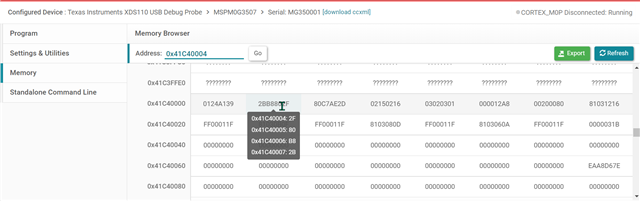
    Below is the method for you to double check whether you have the latest version, use SWD to read the device id from factory region: 0x41C40004

    If the BIT38-31 0x2, then it represents the latest die version. (0x2bb8802f)

    B.R.

    Sal

  • My understanding was that the die version wasn't changed.  Instead, the test regime at manufacture time was changed so that chips with a particular version of the defect were stopped before they reached the wild.  That's why package marking was being used rather than silicon revisions.  If there's a way of being sure that distributors only have later packages (which is apparently *not* the case with TI's own Launchpads) then I'd appreciate the suggestions.