This thread has been locked.

If you have a related question, please click the "Ask a related question" button in the top right corner. The newly created question will be automatically linked to this question.

MSP430G2744: The values ​​0x10F0-0x10FF in Segment A become 0xFF (Blank).

Part Number: MSP430G2744
Other Parts Discussed in Thread: UNIFLASH

Tool/software:

Hi experts,

We're currently investigating an issue very similar to the one in the original thread.

After mounting the MSP430G2744IRHA, the "FET-Pro430" software displays a "Fail" status when writing firmware. Specifically, the values ​​of 0x10F0 to 0x10FF in Segment A are 0xFF (Blank).
Our goal is to determine the cause of the values ​​0x10F0-0x10FF becoming 0xFF (Blank).
Could you please share TI's position on the following points?

Q1: Is there a possibility that data in this area will be erased due to a power surge when power is supplied to the CPU? Please let us know if you have any similar cases.

Q2: Is there a possibility that data in this area will be erased if the circuit deviates from the recommended circuit in the MSP430 Hardware Tools User's Guide (Rev. AH)? Please let us know if you have any similar cases.

Q3: Is there a possibility that data in this area will be erased during mounting or reflow? Please let us know if you have any similar cases.

[Details]

  • This issue only occurred in one lot (250 units), affecting 22/220 units.
  • Reading 30 units from Uniflash using the ICs individually did not return 0xFF (Blank). 
    We are currently requesting implementation and programming of the above 30 units.
  • The circuit and tools used have not changed in nearly 10 years.
  • No significant deviations from the recommended circuit in the MSP430 Hardware Tools User's Guide (Rev. AH) (minor differences in resistor and capacitor values).
    Figure 2-2. Signal Connections for 2-Wire JTAG Communication (Spy-Bi-Wire) Used by MSP430F2xx, MSP430G2xx, and MSP430F4xx Devices
  • Recalibration is possible using "msp430g2x44_dco_flashcal.c."
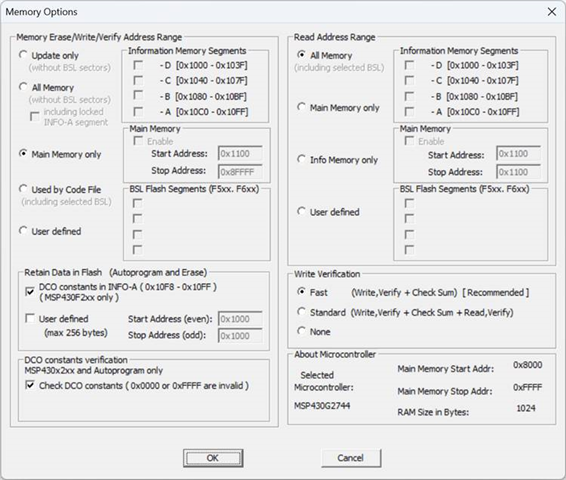
  • The "FET-Pro430" "Memory Option" does not have any effect.
Best regards,
O.H

  • Hi O.H,

    The area that you are trying to modify in the information memory area. Normally, this area should be left alone unless there's a good understanding of how to modify the values here.


    1. I haven't heard of something happening to our devices. The only instance I can think of this happening is if, for some reason, the device was damaged
    2. Similar to the answer above, if the device is damaged, the behavior will be abnormal. Personally, however, I haven't heard of such a case before.
    3. Heat could be a cause for the device to be damaged, especially if it surpasses the recommended operating temperatures. However, heat normally doesn't cause data in FLASH to change (unless it was a FRAM device since FRAM is sensitive to heat.)

    Best Regards,

    Diego Abad 

  • Hi Diego Abad

    Thank you for your supports.

    1. I haven't heard of something happening to our devices. The only instance I can think of this happening is if, for some reason, the device was damaged
    2. Similar to the answer above, if the device is damaged, the behavior will be abnormal. Personally, however, I haven't heard of such a case before.
    3. Heat could be a cause for the device to be damaged, especially if it surpasses the recommended operating temperatures. However, heat normally doesn't cause data in FLASH to change (unless it was a FRAM device since FRAM is sensitive to heat.)

    Based on the answer above, it seems unlikely that the failure is due to a hardware issue.

    My statement may have been a little misleading, so I'd like to provide the following additional information.

    • The error log when the writing failed is below.
      "DCO constants verlifiacation... failed
    • The IC that failed to be programmed was taken from the reel and installed.
    • 220 ICs on the reel have been installed, and the data for the remaining 30 ICs was confirmed using Uniflash.
    • There is no content in the firmware that manipulates 0x10F0-0x10FF.

    Q4: Even with the above information, do you still think the possibility of a hardware-related failure is extremely low?

    Q5: Have there been any reports of bugs with the "FET-Pro430"?

    Q6: Could you tell me how the problem in the original thread was resolved? I don't mind answering in private chat.

    Best regards,
    O.H

  • Hi O.H.,
    Q4. Actually, I think the opposite. There might be a posibility that what the device showing the issue could have been damaged, though I'm not sure exactly how it could have damage.

    Q5. I haven't heard of any in particular, nor I can't find any previous instances in E2E that may relate to it. However, I would recommend browsing in E2E just in case I missed something.

    Q6. Most likely what happened in the original thread is that it automatically got closed after some time. However, I would recommend the same as the original thread on regards of comparing the sections between a good and a bad unit. 

    Best Regards,

    Diego Abad

  • Hi Diego Abad,

    Thank you for your reply. I understood.

    Q6. Most likely what happened in the original thread is that it automatically got closed after some time. However, I would recommend the same as the original thread on regards of comparing the sections between a good and a bad unit. 

    When comparing the units in their implemented state, the defective unit has blank areas, while the good units have no blank areas.
    Since only good units were found in the unimplemented state, we are currently checking whether any defects will occur after implementation.
    We will consult with you again depending on the results.

    Best regards,
    O.H

  • Hi O.H.,

    Sounds good. Let me know if you need further help. Depending of the nature of the question, I may recommend to open a new E2E thread.

    Best Regards,

    Diego Abad

  • Hi Diego Abad,

    Q4. Actually, I think the opposite. There might be a posibility that what the device showing the issue could have been damaged, though I'm not sure exactly how it could have damage.

    Additional question. We understand that the above "could have been damaged" means "physical abnormality," but if the damage is to the circuitry inside the CPU package, We think that even writing the recovery patch ("msp430g2x44_dco_flashcal.c.") would not restore the system.
    Could you please tell me what kind of phenomenon you are referring to when you say "could have been damaged"?

    Additional information.
    The customer checked the source code, but said that LOCKA was not being accessed.

    Best regards,
    O.H

  • Hi O.H.,
    I meant physical damage to the device. Something like the device being exposed to higher currents or voltages that it cannot handle, which leads to internal damage to different parts of the device (including the FLASH or RAM).  It is correct assume that a recovery patch will not work in restoring the MCU to its original functionality if physical damage to the device has occurred. If the LOCKA is not being activated, then that's good since in theory a mass erase will be able to erase the contents in FLASH. 

    Best Regards,

    Diego Abad

  • Hi Diego Abad,

    Thank you for your reply.

    I meant physical damage to the device. Something like the device being exposed to higher currents or voltages that it cannot handle, which leads to internal damage to different parts of the device (including the FLASH or RAM).  It is correct assume that a recovery patch will not work in restoring the MCU to its original functionality if physical damage to the device has occurred. If the LOCKA is not being activated, then that's good since in theory a mass erase will be able to erase the contents in FLASH. 

    In this case, we have confirmed that the device operates normally with the recovery patch. So, is the following understanding correct?
    This is a conclusion based on the assumption that physical damage occurred.

    "The internal flash temporarily failed due to a current or voltage higher than the device could handle. In this case, a temporary failure means that data has been lost (become 0xFF). However, it is not a permanent failure and data can still be rewritten. Due to the fact that it temporarily failed, you cannot guarantee that the device will function as a normal product."

    Best regards,
    O.H

  • Hi O.H.,
    That sounds about right. If the device functions as intended after a recovery fix, then there may not be permanent damage to the device. However, since the device appeared to be corrupted due to an external factor, its lifetime is most likely reduced.
    Best Regards,
    Diego Abad

  • Hi Diego Abad,

    Thank you for your reply. I understood.

    I'll share any additional questions or information I have.

    Best regards,
    O.H

  • Hi O.H.,
    Sounds good from my side. 

    Best Regards,

    Diego Abad

**Attention** This is a public forum
