This thread has been locked.

If you have a related question, please click the "Ask a related question" button in the top right corner. The newly created question will be automatically linked to this question.

AM5728: Power down sequence

Part Number: AM5728
Other Parts Discussed in Thread: TPS3808, TPS54531, TPS659037

Hello,

One of my motor drive customer is using our AM5728 and we have noticed that all the circuit voltages are shutting down together instead of the power down sequence that is mentioned in the datasheet. Can you please tell me if it is a problem? can it cause a damage to the device?

Regards,

Meir.

  • Hi,

    Are they using the recommended PMIC?
    What software are they using?
    How do they power down the system?
  • Yes, it is a problem and can damage the device.
  • Hi Brad,

    The customer implemented his design based on the C2000 guide lines. They are using our TPS6590376ZWSR PMIC. For the board testing they are using a DC power supply, and they are using the ON/OFF switch (of the DC Power Supply) to power up and down the board.
    1. I would expect that if you turn off the DC power supply, that all the voltages will go to "0" after a few milliseconds - isn't it the case?
    2. What might be causing the rails to all ramp down simultaneously instead of following the proper power down sequence?

    Regards,
    Meir.
  • Meir Battan said:
    For the board testing they are using a DC power supply, and they are using the ON/OFF switch (of the DC Power Supply) to power up and down the board

    This is the issue.  The PMIC doesn't have a chance to do a proper shutdown if the power suddenly disappears.  On the EVM the shutdown sequence is analogous to a computer, i.e. when you want to shut it down it's expected that the software initiates a shutdown.  This is important for several reasons:

    1. It allows to cleanly close any open files and unmount the file system.

    2. It allows the PMIC to properly perform the power down sequence.

    Now that said, the method used on the EVM is not the ONLY method of doing the shutdown.  It is still possible to "pull the plug" (though if you have a file system you may eventually corrupt things). This wiki page in the PMIC forum addresses your specific issue:

    https://e2e.ti.com/support/applications/automotive/w/design_notes/3266.should-i-use-powerhold-or-pwron-to-turn-on-the-pmic

  • Hi,

    Thanks for your support - we don't take it for granted.

    I have another questions just to understand the full picture -

    A - If we will stay in current configuration and all rails will power down together, what kind of damage it might cause?

    Is it just the a possibility to harm the file system? can it cause also an hardware damage (processor, DDR etc.)? (the corrupted files will cause an hardware damage?)

    B-  at the moment, the customer had implemented a Supervisor (TPS3808) that supervise the 3.3V input, and the supervisor output is connected to the Reset_In pin of the PMIC - will it be OK to connect the supervisor output to the existing pin (Rest_In) and in addition to that, also to connect it to the powerhold Pin of the Pmic?

    C - about the PMIC configuration - can you clarify if I understand right the link you provided:

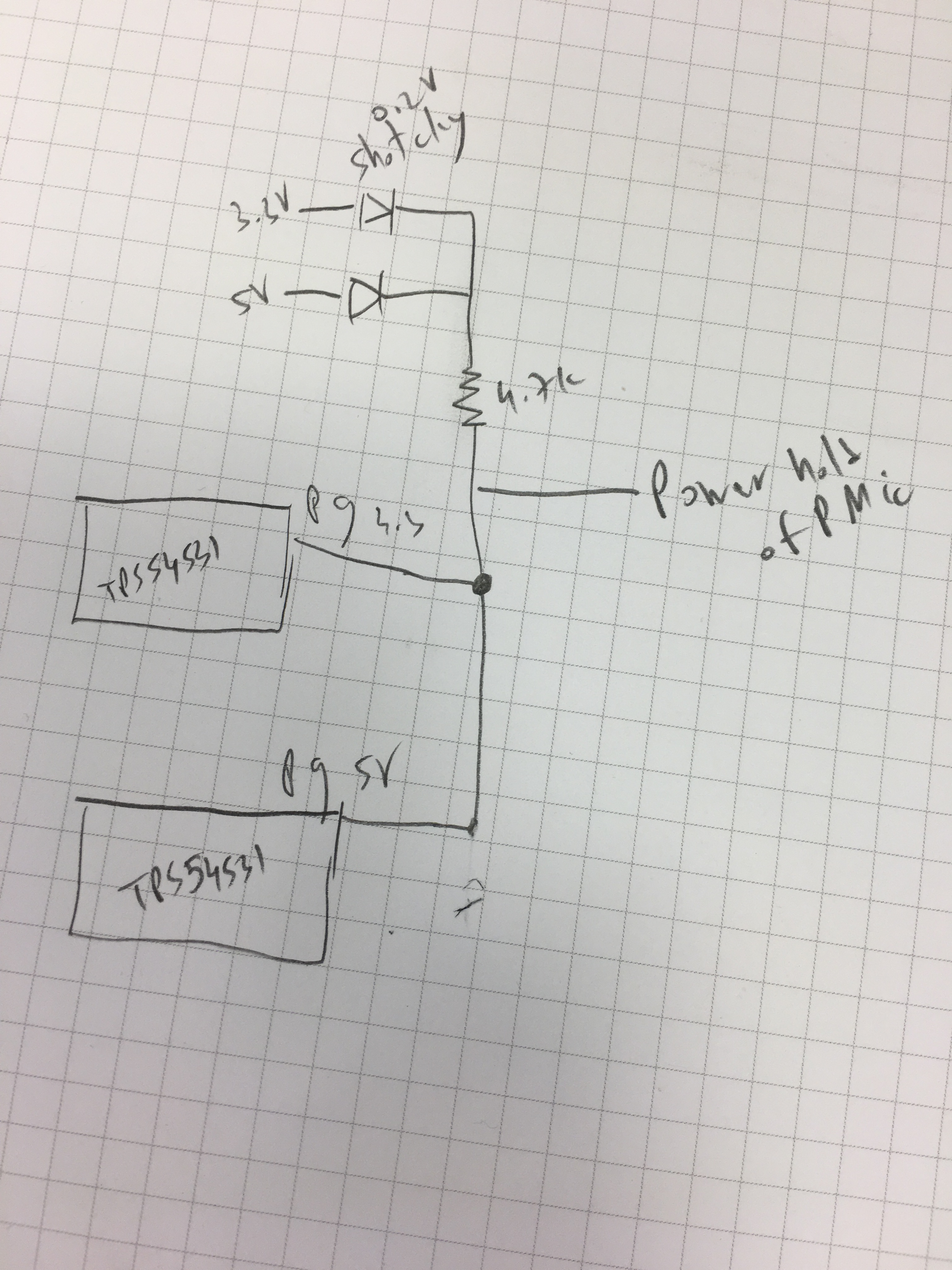
    1. To connect the power good of the buck converters (TPS54531 (5V) and TPS54531 (3.3V)) to the powerhold Pin of the PMIC in this method:

    What you are basically implementing here is an Analog AND Gate – When one of the regulators Power good pin will go Low, your powerhold will go low as well.

    2. Second option is to use a supervisor (Such as TPS3808) to supervise the VCC supply of each regulator (TPS54531) and to connect its reset output (of the supervisor) to the powerhold pin of the PMIC.

    Regards,

    Meir.

    0x80 Block Diagram.pdf

  • Meir Battan said:

    A - If we will stay in current configuration and all rails will power down together, what kind of damage it might cause?

    Is it just the a possibility to harm the file system? can it cause also an hardware damage (processor, DDR etc.)? (the corrupted files will cause an hardware damage?)

    You will damage the chip itself if you don't follow the sequence.  File system corruption relates to turning off power without giving software a chance to close files and unmount the file system.  That issue will still be there even after you fix the sequencing.

    Meir Battan said:

    B-  at the moment, the customer had implemented a Supervisor (TPS3808) that supervise the 3.3V input, and the supervisor output is connected to the Reset_In pin of the PMIC - will it be OK to connect the supervisor output to the existing pin (Rest_In) and in addition to that, also to connect it to the powerhold Pin of the Pmic?

    C - about the PMIC configuration - can you clarify if I understand right the link you provided:

    These questions would be more appropriate in the PMIC forum.

  • Hi Brad,

    Thanks for the answer - I have additional quick question:

    The customer is using our Sitara with the TPS659037 PMIC and they have noticed to a strange behavior of VDD_SD rail (LDO1_OUT of the PMIC) which is connected to two power pins (VDDSHV8) of AM5728 processor and the entire SD CARD user interface (connector, pull ups, ESD protection, etc.).

    The schematic of our SD CARD interface is attached and is identical to the EVM design.

    Please check if this is normal or not and advise.

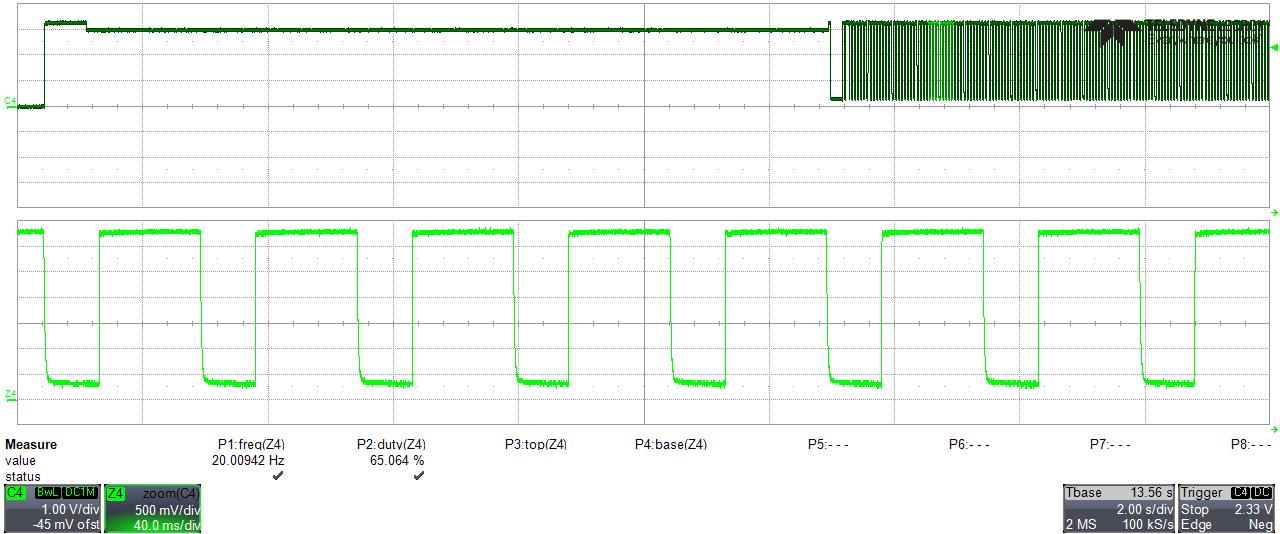
    The behavior they see is as follows (PLOT1 – No SD CARD inside the slot):

    1. At power up when SD CARD is not inside the slot – VDD_SD rail ramp up to 3.3V and then after a period of ~800ms the rail drops to 3V.

    2. VDD_SD rail stays at 3V level for ~12.5s and then is starts to swing with frequency of 20Hz and 65% duty cycle.

    3. Once we insert the SD CARD into the slot and the card is detected, VDD_SD stops swinging and stays at 3.3V level.

    Regards,

    Meir.

    MMC1 - SD CARD.PDF

  • Which SDK version is being used?  From the sound of things, something odd is happening that gets "fixed" once a card is inserted.  I'm wondering if there is software activity that occurs after the card insertion that "fixes" things.  So along those lines, one of the more recent patches from u-boot was this one in the configuration:

    diff --git a/configs/am57xx_evm_defconfig b/configs/am57xx_evm_defconfig
    index 7e7edda..f57fc3a 100644
    --- a/configs/am57xx_evm_defconfig
    +++ b/configs/am57xx_evm_defconfig
    @@ -56,11 +56,13 @@ CONFIG_DRA7_IVA_OPP_HIGH=y
    CONFIG_DRA7_GPU_OPP_HIGH=y
    CONFIG_DISK=y
    CONFIG_DWC_AHCI=y
    +CONFIG_MISC=y
    CONFIG_DM_ETH=y
    CONFIG_DM_PMIC=y
    CONFIG_PMIC_PALMAS=y
    CONFIG_DM_REGULATOR=y
    CONFIG_DM_REGULATOR_PALMAS=y
    +CONFIG_DM_REGULATOR_PBIAS=y
    CONFIG_CMD_TIME=y
    CONFIG_DM_I2C=y
    CONFIG_DM_SPI=y

    I'm wondering if that could possibly be related.