• Join
  • Sign In with my.TI Login
Texas Instruments
  • Products
  • Applications
  • Tools & Software
  • Support & Community
  • Sample & Buy
  • About TI
Sample & Purchase Cart Sample & Purchase Cart
  • Search
  • Advanced
TI E2E™ Community
  • Support Forums
  • Blogs
  • Groups
  • Videos
  • 简体中文
  • More ...
TI Home » TI E2E Community » Support Forums » Amplifiers » Precision Amplifiers » Precision Amplifiers Forum » INA326 EMG amplifier
Share
Precision Amplifiers
  • Forum
  • Announcements
  • E2E Wiki
Options
  • Subscribe via RSS
Check out
The Signal blog
  • $core_v2_blog.Current.Name

    Handy Gadgets and Resistor Divider Calculations

    Posted 7 days ago
    by Bruce Trump
    Handy gadgets make our engineering life easier—the little...
  • $core_v2_blog.Current.Name

    Chopper Op Amps—are they really noisy?

    Posted 14 days ago
    by Bruce Trump
    Chopper op amps offer very low offset voltage and dramatically...
  • $core_v2_blog.Current.Name

    Bypass Capacitors… yes, but why?

    Posted 27 days ago
    by Bruce Trump
    Everyone knows that op amps should have power supply bypass capacitors...

INA326 EMG amplifier

INA326 EMG amplifier

This question is answered
TJ10751
Posted by TJ10751
on Apr 21 2009 05:38 AM
Prodigy165 points

I'm trying to make an EMG front end amplifier with an INA326 and several OP amps for respective HP/ LP filtering. Could someone point me in the right direction with building such a device?

I'll be using filterpro for the hardware HP/LP filters with OP233's. What i understand is that there is no need for a right leg driver, like in ECG designs. I was told to High pass the signal first then low pass it. Wouldn't most of the noise exist in the High Frequency end?

My constraints for EMG are

large muscle use -amplitude from 0-10mV

Smaller muslces - amplitude from 0-1.5mV

0-500Hz freq range, with dominant energy in the 50-150Hz range.

As this EMG device will be on a wireless device, the subject will be moving. Will i need a right leg driver for signal fidelity.


Thanks in advance for any help or advice whatsoever.


instrumentation amplifier
Report Abuse
  • Reply
You have posted to a forum that requires a moderator to approve posts before they are publicly available.
All Replies
  • Matt Hann
    Posted by Matt Hann
    on Apr 21 2009 13:30 PM
    Expert7120 points

    Hello TJ,

    The right leg driver is important for minimizing 60Hz noise; however, depending on the application your overall SNR may be good enough such that you will not need it.  Typically with ECG designs the high pass filtering is accomplished with a servo integrator which removes the DC component and offset of the pulsatile waveform.  Low pass filtering usually is placed differentially and to ground across the inputs of the instrumentation amplifier and also in the successive gain stages following the INA326. 

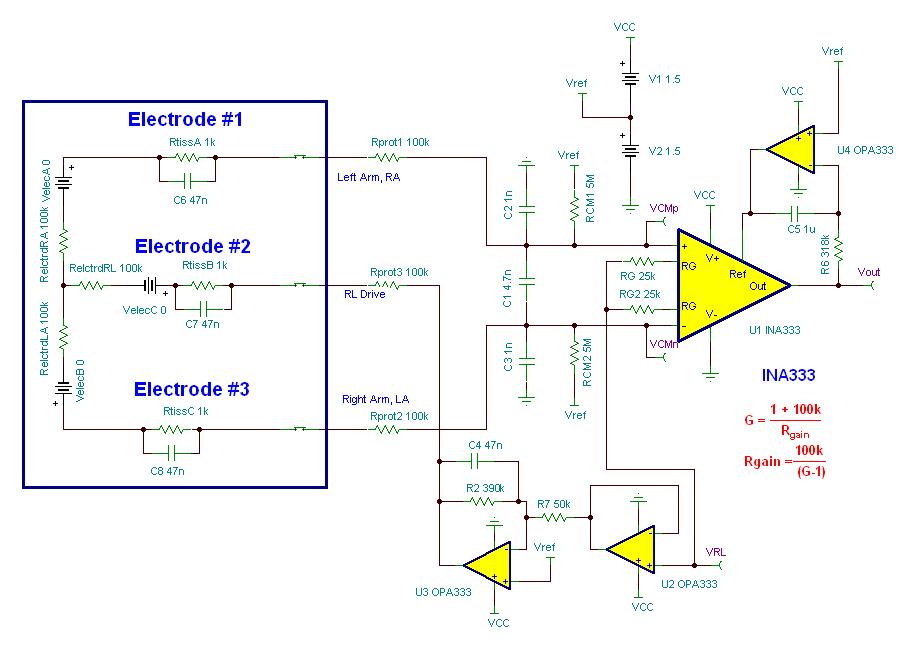
    This may be a bit hard to read, but I have a reference design example for you that illustrates this.  If you do choose to use the right leg drive, you do not necessarily need 2 cascaded amplifiers to do this; 1 should suffice. 


    I hope this helps.

    Matt

    ECG assistance
    Report Abuse
    • Reply
    You have posted to a forum that requires a moderator to approve posts before they are publicly available.
  • TJ10751
    Posted by TJ10751
    on May 05 2009 04:21 AM
    Prodigy165 points


    Hi Matt,

    Thanks for that. This is a part of my final year project in EE so I was a little rusty back then on the design parts. Essentially what I understand is that an ECG and EMG are relatively similar except the filter cut offs are different.

    For the front end of the EMG, I've used an INA326 with a following HPF with a cut off 30HZ, followed by a LPF with cut off at 450HZ with slope of 40dB / decade.

    In the handbook for Biomedical engineering I found that:
    the HPF cut offs should be 10-20Hz for stationary movement, 25-30Hz for movement.
    the LPF cut offs should be at 400-500zHz

    *****************************************************

    1. With reference to the following I found I need a gain of 1000,

    This 2003 Cornel tutorial used an INA121 with a gain of 1000 to best amplify the signal. Hence I was going to go for that.

    http://instruct1.cit.cornell.edu/courses/bionb440/FinalProjects/f2003/knb6/Design.htm

    Would my caluclated values for R1, R2 and C2 be alright based on the above design? I'd have R1 = 4k i.e a pair of 2k's split by the input to the inv right leg, then R2 = 2M, hence C2 = 50pF? based on the relationships from the datasheet and the above diagram.


    *********************************************

    2. Also could I use the same filters used for an ECG inverted Commond mode Right Leg driver for an ECG? It should still be used to remove the 50/60Hz noise i'd assume.

    ***********************************************

    3. Also at some stage, since the final EMG should be connected to my wireless portable instrumentation unit - would I need to use an isolation amplifier to remove any electrical connections to the main board or the patient?

     **********************************

    4. What gains should I be looking at HP and LP filter for an EMG - will it be the same as the ones chosen for an ECG? i.e. a gain of 1 for the HPF, and again of 300 for the LPF?

    I've seen an ECG design using a 300x and another using 200x gain on LPF.

    ****************************************************************

    5. Is linear phase resilience needed for EMG’s usually? Should I go for a Bessel or for sharper roll offs by choosing butterworths?

    This paper in the Journal of Medical Systems published in 2004 used all Butterworths solely for the fast attenuation and sharp cut offs.

    http://www.springerlink.com/content/l1t6v27853674866/fulltext.pdf

    **************************************************************

    6. Why do we need to power certain op amps at half V+ ?

    Thanks in advance for all your help. I’m glad the TI community is so helpful.

    Thanks in advance for all your help.

    Report Abuse
    • Reply
    You have posted to a forum that requires a moderator to approve posts before they are publicly available.
  • TJ10751
    Posted by TJ10751
    on May 05 2009 04:36 AM
    Prodigy165 points

    Actually I found something

    The Implementation of an EMG Controlled Robotic Arm to Motivate Pre-College Students to Pursue Biomedical Engineering Careers
    Quote: http://ieeexplore.ieee.org/stamp/stamp.jsp?arnumber=01280910

    "The signal is amplified by a gain of 1000 so that small changes in the milli-volt signal can be readily seen. Isolation is explained as a safety protocol to eliminate electrical shock, from the wall outlet's AC power supply, to the person producing the EMG signal. This is shown as an electrical engineering component of the demonstration."

    Even though my EMG front end will be powered from a 3.3V Lithium Ion battery (BQ232) would I still need electrical isolation?

    Report Abuse
    • Reply
    You have posted to a forum that requires a moderator to approve posts before they are publicly available.
  • Matt Hann
    Posted by Matt Hann
    on May 06 2009 18:06 PM
    Expert7120 points


    ECG and EMG Designs
    Report Abuse
    • Reply
    You have posted to a forum that requires a moderator to approve posts before they are publicly available.
  • Matt Hann
    Posted by Matt Hann
    on May 06 2009 18:23 PM
    Expert7120 points

    TJ,

    As a preface to answering your questions, understand that there are many different ways to design a good ECG/EEG front end; the example that I gave you was just that--an example.  How one tailors the front end is based on the grade of the instrument, cost, and the environment in which it will reside.  Therefore, to answer your question in one of your following posts, if you are powering your ECG front end from a Lithium battery, there is not really a need to have an isolation barrier between the patient and the ECG circuitry.

    1. With reference to the following I found I need a gain of 1000,

    This 2003 Cornel tutorial used an INA121 with a gain of 1000 to best amplify the signal. Hence I was going to go for that.

    http://instruct1.cit.cornell.edu/courses/bionb440/FinalProjects/f2003/knb6/Design.htm

    Would my caluclated values for R1, R2 and C2 be alright based on the above design? I'd have R1 = 4k i.e a pair of 2k's split by the input to the inv right leg, then R2 = 2M, hence C2 = 50pF? based on the relationships from the datasheet and the above diagram.

    Answer:  Instead of telling you what values you should use, I think it would be more beneficial to highlight the ECG design strategy.

    Your overall strategy for segmenting the first gain stage is based on the worst-case AgCl electrode offset (generally 200mV-300mV), the offset of the instrumentation amplifier (i.e. INA326 or INA121), and the output swing limitations of the INA.  Getting as much gain out of this stage as possible is best for an optimal design because it helps set your overall SNR (signal-to-noise ratio) which is the most important care about in this type of application.  It would be counterproductive for you to set your gain so high that under some modes the output of the INA saturates; therefore, in most cases the gain of this stage is typically in the range of 5-10.  The gain of the following stage is dependent on the input range and resolution of your ADC.  Whether your following stage is a gain of 500 or 1000 is dependent on the MAX signal you expect out of your INA and the MAX signal that can be handled by the ADC inputs.  As an example, if you post gain output of your INA is +/10mV and your ADC is input range is limited to 200mV from your 3.3V rail, the MAX signal that it can see is 3.3V-200mV = 3.1V – (midscale = 1.65V) = 1.45V.  Therefore, the gain along the entire post signal chain following your ECG amplifier is 1.45V/VoutINA.  Note that this calculation does not take into account the p-p noise of the successive devices; therefore, this will have to be considered as well.

    The cutoff frequencies that you select (and their corresponding component values) will be based on the resistors that you select for the signal change.  The integrating amplifier in the feedback INA servos to eliminate the DC offsets from the front end, leaving the remaining amplifiers to amplify only AC signals.  The low pass cutoff of the remaining amplifiers should not exclude those heart rates that reside in a normal population (i.e 120Hz).  Unfortunately, 50/60Hz noise is a HR frequency of interest—this is removed with CM feedback and sampling at frequency multiples common to these.


    *********************************************

    2. Also could I use the same filters used for an ECG inverted Commond mode Right Leg driver for an ECG? It should still be used to remove the 50/60Hz noise i'd assume.

    Answer:   I assume you meant EMG? 

    The RL drive in an ECG system is not just for helping reduce 50/60Hz noise.  It also is an accepted standard reference point from which the common mode voltage is established.  Different lead configurations in an ECG system yields different information that may be useful in diagnosing certain heart abnormalities. 

    Though I am less familiar with EMG, I think that the placement of the reference (CM) electrode will drastically effect the noise attenuation of your pre-amplifier and the information that you convey in your signal processing.  In ECG the right leg is a very standard reference and works because the noise present in the ECG signal is mostly “common” with respect to the right arm and left arm.  In EMG you could be interested in a variety of different muscle action potentials and the placement of your differential electrodes is critical to the information and muscle action of interest.  The placement of the electrodes and their distance apart might also be critical because unwanted EMF’s generated by neighboring muscle groups could corrupt the measurement.  Likewise, your common electrode point will vary depending on the muscle in question.  I could also see that if your reference electrode was not placed properly that feeding back an already noisy signal might alias your differential EMG signal of interest.

    I think that if it is possible to choose a benign common point like an adjacent tendon would be best for the reference electrode.  This would reduce the amount of coupling of unwanted action potentials that could corrupt your desired signal.  Of course, if you have perfect symmetry from your 2 electrodes this is a non-issue, but this is very difficult to do from a physiological standpoint. 

    ***********************************************

    3. Also at some stage, since the final EMG should be connected to my wireless portable instrumentation unit - would I need to use an isolation amplifier to remove any electrical connections to the main board or the patient?

    Answer:  Not if you are powering your system from a Lithium Battery.

     **********************************

    4. What gains should I be looking at HP and LP filter for an EMG - will it be the same as the ones chosen for an ECG? i.e. a gain of 1 for the HPF, and again of 300 for the LPF?

    I've seen an ECG design using a 300x and another using 200x gain on LPF.

    Answer:  See answer to #1

    ****************************************************************

    5. Is linear phase resilience needed for EMG’s usually? Should I go for a Bessel or for sharper roll offs by choosing butterworths?

    This paper in the Journal of Medical Systems published in 2004 used all Butterworths solely for the fast attenuation and sharp cut offs.

    http://www.springerlink.com/content/l1t6v27853674866/fulltext.pdf

    Answer:  The measurement in question is much more local and is susceptible to cross talk and noise from adjacent muscular contractions.  Therefore, the frequency bands of interest require sharper filtering than a Bessel filter could provide and better flatness than a Chebyshev could produce.

    **************************************************************

    6. Why do we need to power certain op amps at half V+ ?

    Answer:  You are not powering the OPA’s with V+/2, you are BIASING them at half supply because the example that was given is a single supply application.  This centering optimizes the design in the middle of the common mode range of the INA326 and it biases the DC level of the output to mid supply which allows symmetric signal amplification at the output.


    ECG and EMG Designs
    Report Abuse
    • Reply
    You have posted to a forum that requires a moderator to approve posts before they are publicly available.
  • Matt Hann
    Posted by Matt Hann
    on May 06 2009 18:28 PM
    Expert7120 points

    TJ,

    One more comment regarding CM feedback and EMG--because of the potential pitfalls and difficulties with the common reference, it may just be better NOT to feed back to cancel noise.  This might be something you could determine empirically, but to know for sure whether it is better or not you would have to have an idea of what your ideal differential signal output for a given muscle contraction might be.

    Matt

    ECG and EMG Designs
    Report Abuse
    • Reply
    You have posted to a forum that requires a moderator to approve posts before they are publicly available.
  • TJ10751
    Posted by TJ10751
    on May 07 2009 03:32 AM
    Prodigy165 points

    Matt, I can't thank you enough. Thank you so much for your help.


    -tj

    Report Abuse
    • Reply
    You have posted to a forum that requires a moderator to approve posts before they are publicly available.
  • Carlos Anibal Torres
    Posted by Carlos Anibal Torres
    on Aug 25 2009 22:59 PM
    Prodigy50 points

    Hello, I'm building something similar to what you did, but is for EOG, electroocullography, I'm measuring eye balls potentials, is similar to what you did but whit one more step of amplifiers to achieve my desired gain. did the design with the INA326 work properly?

    thanks

    Report Abuse
    • Reply
    You have posted to a forum that requires a moderator to approve posts before they are publicly available.
  • TJ10751
    Posted by TJ10751
    on Aug 25 2009 23:32 PM
    Prodigy165 points

    Hi Carlos.


    Yes it did. In fact all you need to do for the EMG is set up an instrumentation amplifier of a gain of your choosing. Then HPF then LPF depending on the frequency band that is most important to you.


    best of luck

    Report Abuse
    • Reply
    You have posted to a forum that requires a moderator to approve posts before they are publicly available.
  • Carlos Anibal Torres
    Posted by Carlos Anibal Torres
    on Aug 25 2009 23:38 PM
    Prodigy50 points

    thanks TJ

    Report Abuse
    • Reply
    You have posted to a forum that requires a moderator to approve posts before they are publicly available.
  • eric gatto
    Posted by eric gatto
    on Oct 07 2009 12:15 PM
    Verified Answer
    Verified by Matt Hann
    Prodigy30 points

    ADC with high bits, say 24 bits (e.g. ADS1258, ADS1278), can help to reduce the pressure of filters

    Some of the filters are not necessay.  See "Analog Front-End Design for ECG Systems Using
    Delta-Sigma ADCs"

    http://focus.ti.com/lit/an/sbaa160/sbaa160.pdf

    Report Abuse
    • Reply
    You have posted to a forum that requires a moderator to approve posts before they are publicly available.
  • Paul Bjork
    Posted by Paul Bjork
    on Nov 12 2009 13:34 PM
    Prodigy60 points

    Matt,

    I'm working on a very similar design using an INA333 and OPA2333 for low power.  It is battery powered to +/- 1.5V and the circuit is well laid out.  I understand the importance of the input common mode range and varying electrode offset potentials.  Same gains as your circuit, overall bandwidth 150Hz.  I have what seem to be two independent problems:


    1) The electrode offset potentials can be as high as +/- 250mV.  This plays havoc with the reference offset capability for ac coupling on the INA333.  I frequently hit the negative or positive rail on the high pass filter opamp leading to the reference input of the INA.  I tried adding a trimpot through a 1M resistor leading to one of the INA inputs, but of course that merely shifted the Right Leg drive feedbackup or down, thereby moving BOTH electrodes up and down.  Did not remove the net electrode offset, but did allow me to move the ac reference feedback back into linear range.  Do I have options?  Right now I'm using cheap dry electrodes, and I want the product to be inexpensive and insensitive to this problem.


    2)  I've carefully analyzed the CMRR on the INA333 in this application.  The 60Hz rejection is terrible.  Pretty much 0dB rejection.  I have a 0.1uF cap on the 1/2 Vs line to the minus rail, and a few 1uF cap between plus and minus rails.  Obviously I can't put one on the reference input of the INA.  The plus and minus rails and the reference input to the INA look rock solid at 60Hz: nothing there.  The INA inputs, the plus and minus gain resistor Rg terminals of the INA, as well as the midpoint of Rg all have maybe 10mV of 60Hz, all in phase with each other.  The INA inverting output is maybe 50mV, and is 180 degrees out of phase with the Rg terminals.  This is with the reference input in linear range, somewhere near the midpoint.  The electrode inputs may be at up to 0.5V apart ( see 1) above).  It may be possible that the electrode offset violates the INA input common mode range, but the trimpot adjustment from 1) allows me to adjust CM to 0V, without helping the 60 behavior.  Can you suggest anything?


    The ECG circuit you posted on 4/21/09 is fuzzy.  Can you post a higher resolution copy, please?  Thank you.

    Paul

    ECG INA 133 CMRR EOG
    Report Abuse
    • Reply
    You have posted to a forum that requires a moderator to approve posts before they are publicly available.
  • Matt Hann
    Posted by Matt Hann
    on Nov 12 2009 15:34 PM
    Expert7120 points

    Paul,

    Is it possible for you to post your circuit just so I can make sure that can match the details in your text with your circuit configuration? 

    Thanks,

    Matt

    Report Abuse
    • Reply
    You have posted to a forum that requires a moderator to approve posts before they are publicly available.
  • Paul Bjork
    Posted by Paul Bjork
    on Nov 12 2009 17:37 PM
    Prodigy60 points

    Matt, here's a sanitized version:

    5340.CMRR help.pdf

    Report Abuse
    • Reply
    You have posted to a forum that requires a moderator to approve posts before they are publicly available.
  • Matt Hann
    Posted by Matt Hann
    on Nov 12 2009 17:48 PM
    Expert7120 points

    Thanks Paul.  I'll look at this and get back to you.

    Report Abuse
    • Reply
    You have posted to a forum that requires a moderator to approve posts before they are publicly available.
123
TI E2E™ Community
  • Support Forums
  • Blogs
  • Videos
  • Groups
  • Site Support & Feedback
  • Settings
TI E2E™ Community Groups
  • TI University Program
  • Make the Switch
  • Microcontroller Projects
  • Motor Drive & Control
Other Communities
  • Deyisupport
  • Designsomething.org
  • beagleboard.org
  • TI on Element 14
  • TI on TechXchangeSM
Other Technical & Support Resources
  • WEBENCH® Design Center
  • Product Information Centers
  • Technical Documents
  • TI Design Network
  • TI Technical Articles
  • TI Training

All content and materials on this site are provided "as is". TI and its respective suppliers and providers of content make no representations about the suitability of these materials for any purpose and disclaim all warranties and conditions with regard to these materials, including but not limited to all implied warranties and conditions of merchantability, fitness for a particular purpose, title and non-infringement of any third party intellectual property right. TI and its respective suppliers and providers of content make no representations about the suitability of these materials for any purpose and disclaim all warranties and conditions with respect to these materials. No license, either express or implied, by estoppel or otherwise, is granted by TI. Use of the information on this site may require a license from a third party, or a license from TI.

Content on this site may contain or be subject to specific guidelines or limitations on use. All postings and use of the content on this site are subject to the Terms of Use of the site; third parties using this content agree to abide by any limitations or guidelines and to comply with the Terms of Use of this site. TI, its suppliers and providers of content reserve the right to make corrections, deletions, modifications, enhancements, improvements and other changes to the content and materials, its products, programs and services at any time or to move or discontinue any content, products, programs, or services without notice.

Follow Us Texas Instruments on Facebook Texas Instruments on Twitter Texas Instruments on LinkedIn Texas Instruments on Google+
TI Worldwide | Contact Us | my.TI Login | Site Map | Corporate Citizenship | mobile m.ti.com (Mobile Version)

TI is a global semiconductor design and manufacturing company. Innovate with 100,000+ analog ICs and
embedded processors, along with software, tools and the industry’s largest sales/support staff.

© Copyright 1995-2013 Texas Instruments Incorporated. All rights reserved.
Trademarks | Privacy Policy | Terms of Use