Other Parts Discussed in Thread: OPA197, OPA228, TINA-TI, OPA202
Dear Technical Support Team,
Are OPA196 and OPA197 unity gain stable?
Datasheets described unity gain bandwidth.
Do you have selection guide for unity gain stable?
Best Regards,
ttd
This thread has been locked.
If you have a related question, please click the "Ask a related question" button in the top right corner. The newly created question will be automatically linked to this question.
The OPA196/7 are unity-gain stable. Decompensated opamps (like the OPA228) are marked as such in the datasheet and in the search function (it's a checkbox in "Features"), and specify the minimum closed-loop gain in the electrical characteristics.
TTD,
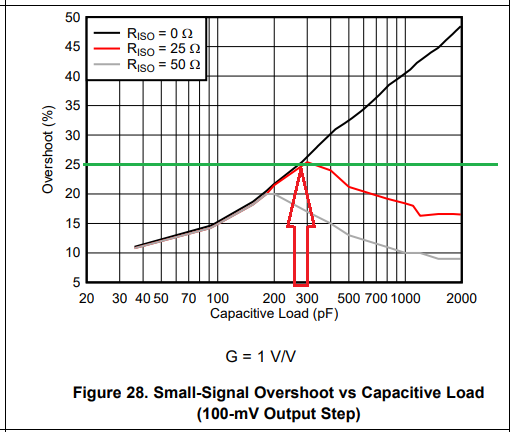
OPA196 and OPA197 are unity-gain stable but when driving directly (with no Riso resistor) their capacitive load is limited. Thus, for example, OPA197 graph shows that driving 300pF load the small-signal overshoot is 25% (the maximum recommended to assure stability over process variation) - see below.

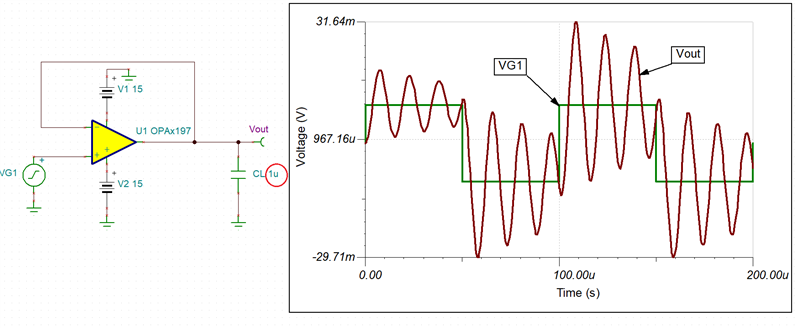
Thus, for example, you cannot drive directly 1uF load - see below.

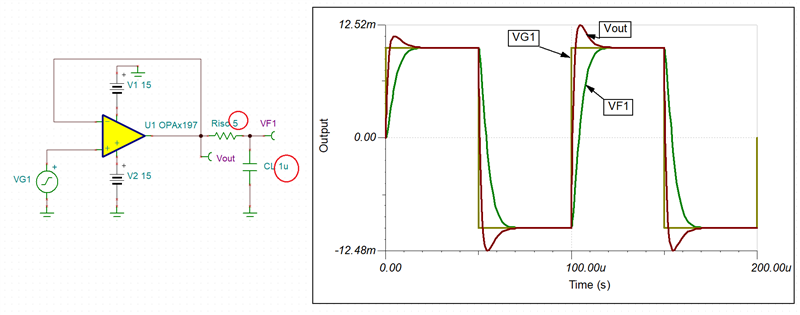
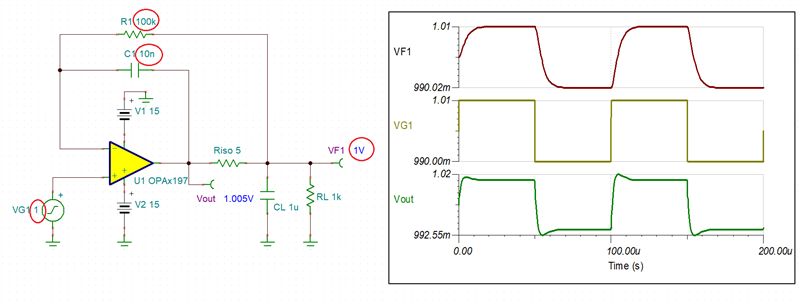
However, adding just 5 ohm Riso resistor makes the circuit stable - see below.

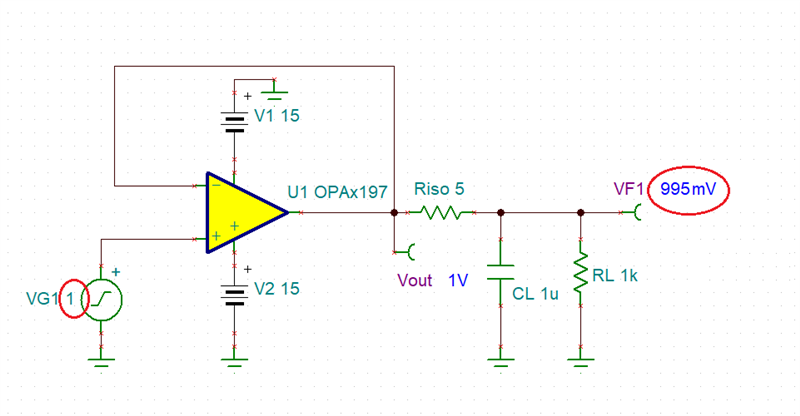
The above solution works well if there is no resistive load, which otherwise would cause a gain error - see below.

Thus, to solve the gain error problem the solution is to use dual-feedback compensation as shown below.

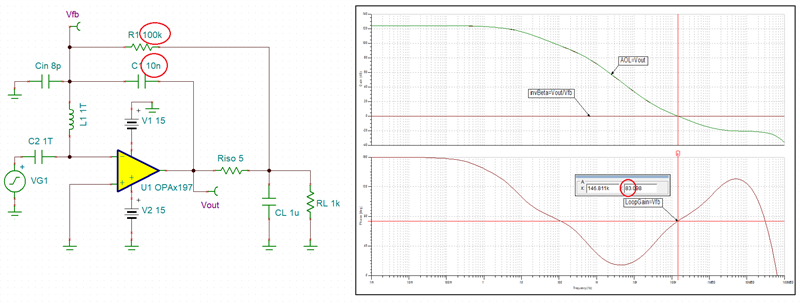
To confirm stable operation you may also run AC stability simulation showing 83 degrees phase margin whereas the minimum recommended is 45 degrees - see below.

Please review circuit stability training material under following link:
Below I have attached Tina-TI schematics for your own simulations.