A related question is a question created from another question. When the related question is created, it will be automatically linked to the original question.
If you have a related question, please click the "Ask a related question" button in the top right corner. The newly created question will be automatically linked to this question.
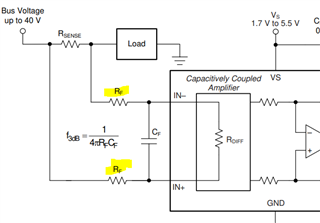
As Kai mentioned, Section 8.1.3 of the INA186 datasheet further describes this input filter. Additionally, we have a TIPL training video: 3.9 Input filter error, that explains how to calculate and analyze the resulting error from input filters.
Using an input filter helps filter out load current or Vshunt noise. The input filter does not improve the inherent noise of the device.
Rf can affect gain error according to Equation 5 provided in datasheet. A differential capacitor (Cf) should always be used if using input resistors. Cf helps stabilize the differential input voltage as internal capacitors are switching. Usually >500 pF is sufficient.
To determine the Rf and Cf values, you need to know the minimum signal BW required for the system, and/or the load noise frequencies you want to attenuate. I recommend using Rf < 500 Ω and fc = 50 kHz, thus Cf = 1 / (2 * 2 * π * Rf* fc). We'd recommend fc to be slightly higher than the highest BW (45 kHz for INA186A1 variant). We recommend Cf be aC0G (NP0)capacitor type. With this you do not sacrifice any signal BW, but attenuate higher frequency transient noise.