Part Number: LMH6720
Tool/software:
Hello,
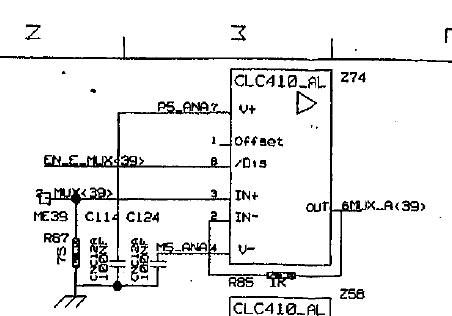
We have replaced the CLC410 on a board with the LMH6720.
See doc attached we have oscillations, which does not exist with the CLC410 mounted on the same card.
Thank you for your help.
This thread has been locked.
If you have a related question, please click the "Ask a related question" button in the top right corner. The newly created question will be automatically linked to this question.
Part Number: LMH6720
Tool/software:
Hello,
We have replaced the CLC410 on a board with the LMH6720.
See doc attached we have oscillations, which does not exist with the CLC410 mounted on the same card.
Thank you for your help.
Hi,
I was able to look into the schematic you shared and did not find anything concerning with the configuration of the LMH6720. It does look like it could be a stability issue. Just to confirm, is the voltage supply of the device +/-5V? I was also wondering if you were probing directly at the output pin. With some devices we recommend probing on the other side of a series resistor as the capacitance at the probe can be enough to cause stability issues. Probing on the other side of a series resistor will isolate any parasitic capacitance from the probe. I was also wondering if you could adjust the Rf and Rg to 300ohms. As this is a current feedback device, the stability of the device depends on the value of the feedback resistor. For this device, 300ohms is the recommended value in a gain of 2V/V. I do not believe this will make a difference, but it is good to rule out variables.
Best Regards,
Ignacio
Hi,
I can confirm that the supply voltage is +/-5V.
We are going to test with Rg=Rf at 300R.
Another question: we also use the amplifier with this follower circuit.
I haven't found anything in the datasheet that explains the value of the feedback resistor in tracking mode. Why 1K? Refer to the document attached.
Do you have a note explaining how the LMH6720 works in tracking mode?

Thanks for your help
Best regards
Hi,
It is expected for current feedback devices to have an Rf resistor in a buffer configuration to maintain stability. The value is dependent on the device itself and with this case it was likely increased to further stabilize the device as the recommended was 402ohms. For current feedback devices, the stability is primarily dependent on the Rf resistor. There is a noise gain and input buffer output resistance term to consider but it will mostly depend on the feedback resistance value. As the feedback resistor decreases, you decrease your phase margin and ultimately reduce stability. This is why we use a feedback resistor in follower configurations when using a current feedback device. For the LMH6720 it is recommended to use 600ohms. Figures 8 and 9 in the datasheet highlight the frequency response for the LMH6720 in a follower configuration for reference.
Best Regards,
Ignacio