This thread has been locked.

If you have a related question, please click the "Ask a related question" button in the top right corner. The newly created question will be automatically linked to this question.

ALM2403-Q1: ALM2403: Current Output

Part Number: ALM2403-Q1
Other Parts Discussed in Thread: OPA598, OPA593

Hi Team, 

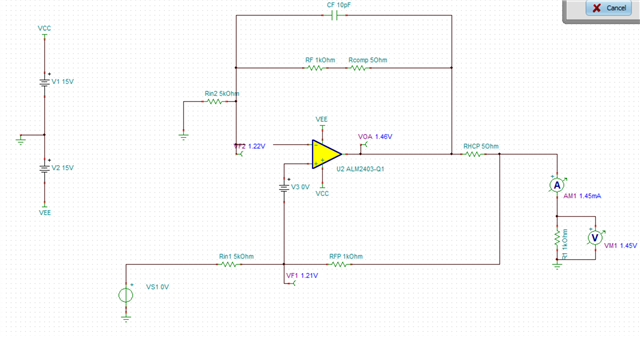
We have been using the ALM2403 IC for current output application. Please find the circuit below. 

We have set like for 10V the circuit will provide 400mA.

For 333 ohm load resistor we are getting 20mA by setting the input voltage of 498mV. 

But for 1Kohm load resistor we could see a difference of +/-2mA practical. While simulating we could see a difference of 1.45mA for current vlaues from 1 to 10mA.

Could you please help us understand the reason for this variation?

Are there any limitations in using this circuit with higher load resistances?

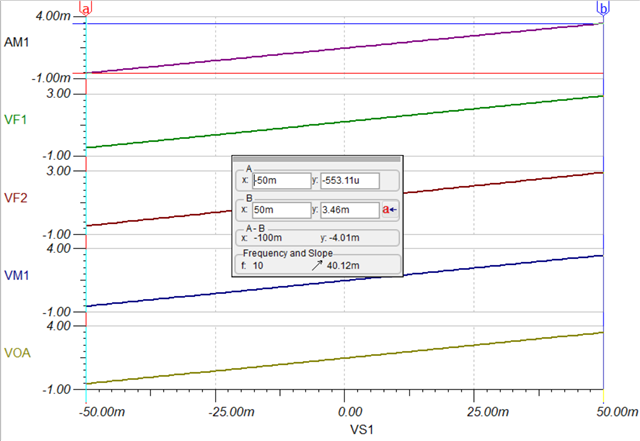
The simulated output graph is attached for reference. 
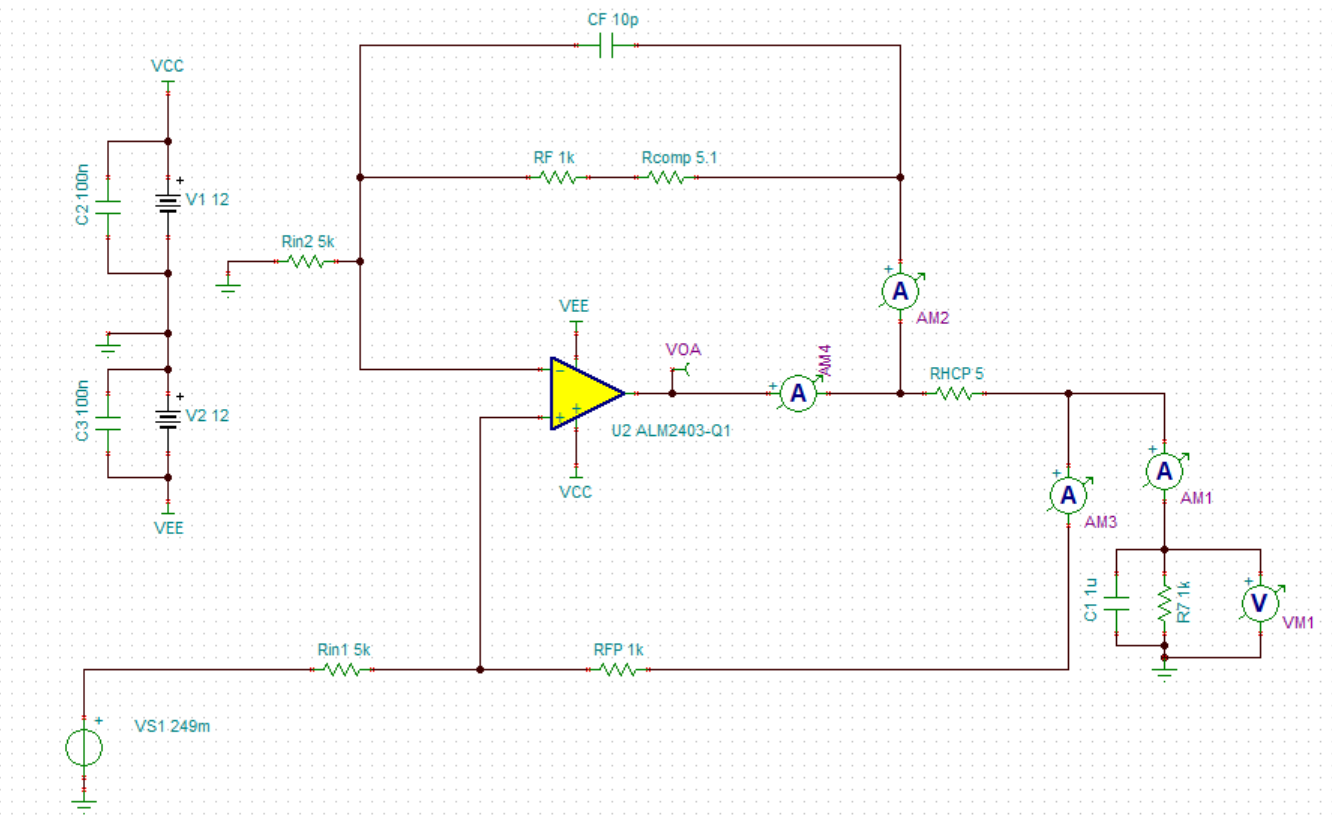
image.png

image.png


  • Hi Lathaniveatha,

    Good to hear from you again. 

    Let's start with what may be going on:

    Remember, ALM2403-Q1 is not particularly accurate when it comes to power op amps:

    In this configuration, we are applying a gain of 1.2V/V to the VS1 terminal, causing all Vos to be multiplied by this value. 

    The real error however comes from the positive feedback deriving from the current sense. 

    looking into VS1, the transfer function ends up being Iout = ~40.1mA/V

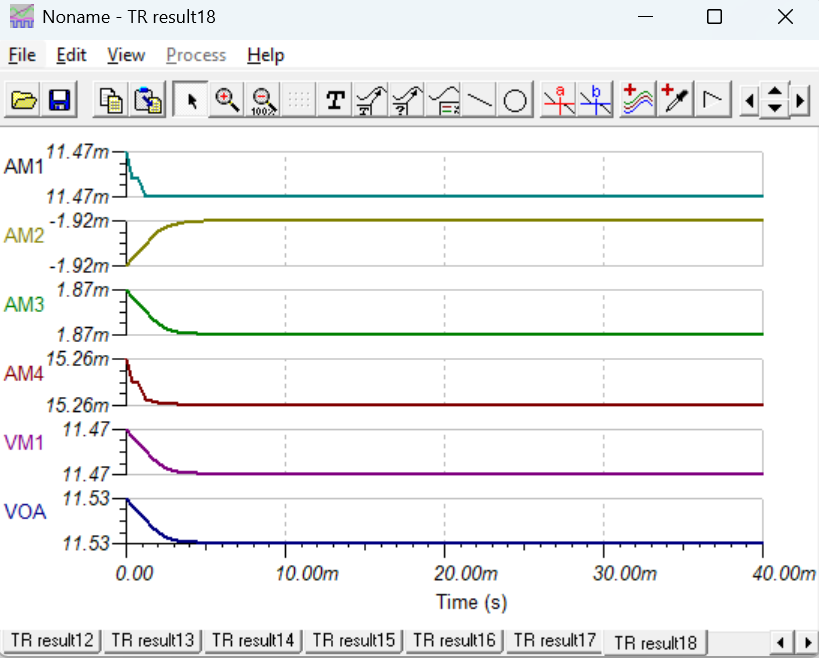
    If I look at this circuit, I see the offset you mention (1.45mA)

    Note, this error is coming from the natural typical offset of the ALM2403-Q1 being about 6mV input referred. 

    Solutions to remove this error would involve using a DAC or a potentiometer to null out the offset. 

    The easiest solution may be to use something like OPA593 or even OPA598 with two amplifiers in parallel. 

    OPA598 is a single channel chip, but the max Vos is just 1mV compared to the 25mV of the ALM2403. 

    If you want ultra-precision, the OPA593 is industry leading for VOS performance in a power amplifier. 

    The dual solution would increase the solution cost, and add some complexity in the parallel design, but realize excellent performance. 

    Going back to our data, ALM2403 will have a typical current error of +-1.45mA, compared to OPA593 with just 18uA of typical error:

    Again however, a parallel structure would be required for operation at up to 400mA current source. 

    Please let me know what direction you would like to pursue, I can help offer design guidance. 

    Thanks,

    Jacob