This thread has been locked.

If you have a related question, please click the "Ask a related question" button in the top right corner. The newly created question will be automatically linked to this question.

[ OPA454 ] E/D and E/D Com Connection

Other Parts Discussed in Thread: OPA454

[ OPA454 ] E/D and E/D Com Connection

Hi expert,

Can you help me to understand the detail of E/D and E/D Com pin more clearly?
As I indicated below, we have some options to disable “ENABLE/DISABLE” function (let OPA454 output always on).
However, the last approach “Choosing RP to be 1 MΩ with a +50-V positive power supply voltage results in IP = 50 μA.” is confused me a bit.
I’m not sure whether this approach does meet with absolute max specification of E/D and E/D Com pin.


Also, datasheet suggests the different approach to keep output stage on.
It’s really appreciated, if you can help me to understand!
Thanks,
Ken


Other good references

OPA454
e2e.ti.com/.../226867

OPA454 E/D logic connection
e2e.ti.com/.../268763

OPA454 shutdown operation
e2e.ti.com/.../518375

OPA454 - Cannot enable output; E/D draws large current

e2e.ti.com/.../1501684

  • Hello Kenichiro,

    It appears your understanding of the OPA454 E/D for enabled state is correct. The first circuit you show is one I would not recommned as well based on the comments mentioned in datasheet sction 9.3.6. The second circuit, that provides ac bypassing of the pin, should provide a simple, usable solution.

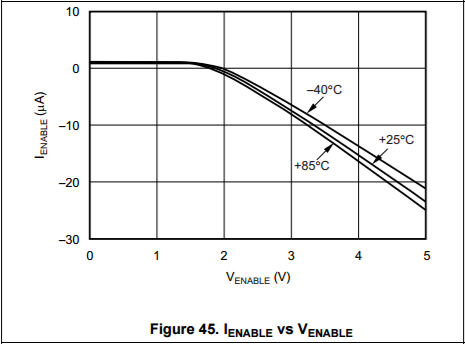
    The third soultion using the 1-Megohm resistor relies on the point that the E/D draws more current as the applied voltage on the pin is increased. This can be seen in datasheet graph, Figure 45. Section 9.3.6 indicates the Ip will be 50 uA, but the graph indicates that the current may be closer to 25 uA, which would result in only a 25 V drop across the 1-Megohm resistor. It is apparent that an Ip current higher than 25 uA flows and the voltage on the E/D pin assumes a level somewhat higher than 5 V. It musn't be high enough to cause voltage breakdown of the E/D circuit. However, even if something did go into breakdown the 1-Megohm resistor would limit the current to 50 uA which isn't likely to allow any damage. I have actually used the 1 Megohm Rp in test circuits operating from +/-50 V supplies and observe any problems. However, I understand your concern.

    It would appear that increasing Rp would provide a safer solution. Using the Figure 45 curve we see that with a Venable of 4.5 V the Ienable is about 20 uA. If Rp is made a 2.2 Meg resistor about a 45.5 V voltage drop will accur across it. The E/D pin would then be biased to achieve a level about 4.5 V.

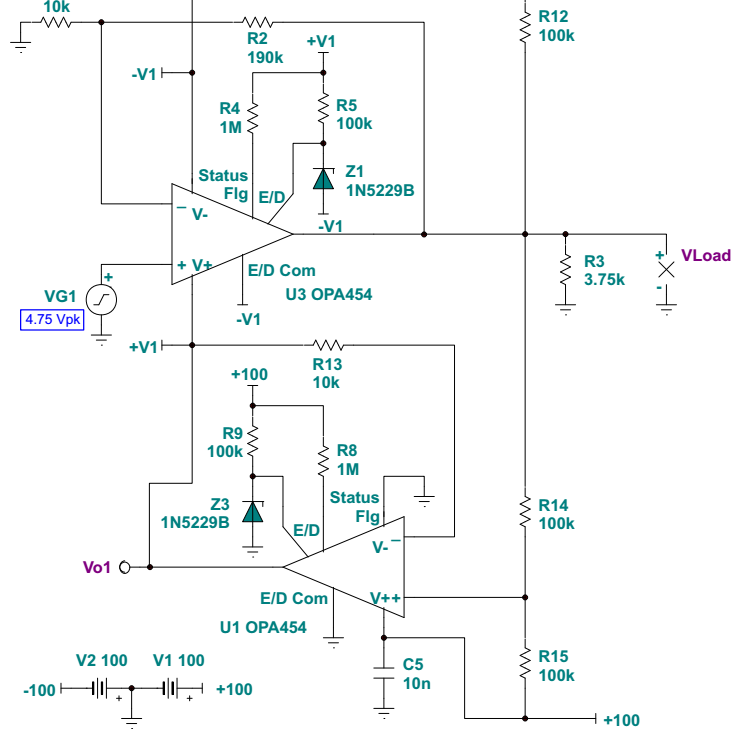
    The other method of biasing the pin to a known level is to apply a zener diode as shown in the OPA454 applications circuit. In that application a 1N5225, 4.3 V zener is connected between E/D and E/D common. Rp is reduced to 100 kOhm to provide reverse current for the zener diode. Using the zener removes the risk of over-voltage on the E/D pin and keeps it biased at about 4.3 V.

    Regards, Thomas

    PA - Linear Applications Engineering

  • Hi Thomas,

    Sorry for my reply being late!
    This is what I want to hear from you, it's really helpful!

    I'm still supporting my customer for this project.
    I would post an additional issue, they are facing now, appreciated if you can look into that post, too.

    OPA454: [ OPA454 ] Start-Up Issue and Output during disable
    e2e.ti.com/.../561711


    Thanks,
    Ken