This thread has been locked.

If you have a related question, please click the "Ask a related question" button in the top right corner. The newly created question will be automatically linked to this question.

INA214-Q1: Can I add resistor at IN+ and IN- pins to change gain?

Part Number: INA214-Q1
Other Parts Discussed in Thread: TINA-TI, INA214

Hi team,

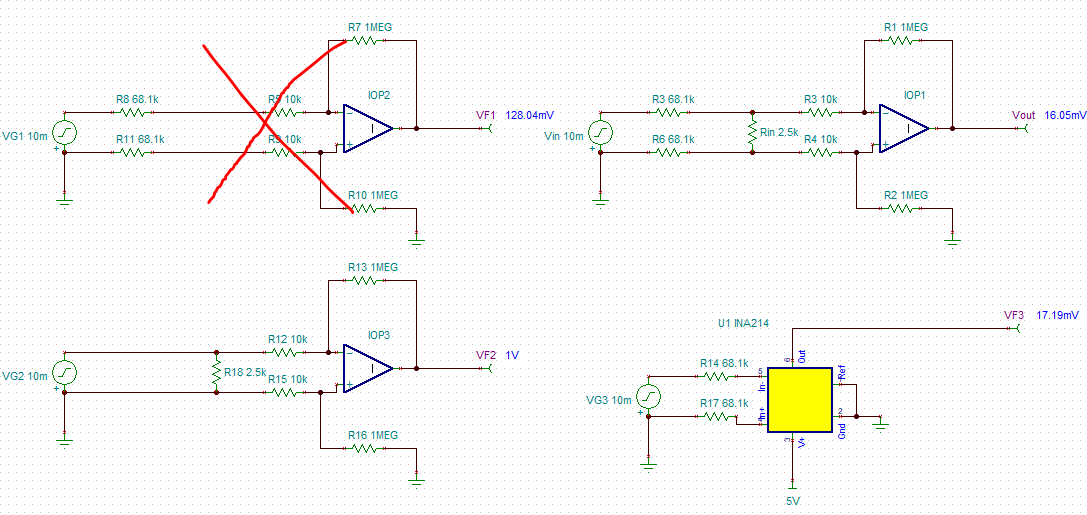
As we know, the gain of INA214-Q1 is 100V/V. My customer want to have adjustable gain, so they add resistors as below to reduce the gain.

They think the gain equals to R1/R3 or R2/R4, so they add external resistor in series with R3 and R4 to reduce the gain. The external resistors they add are 68.1k, so they think the gain should be R1/(R3+68.1K)=12.8, but the test result shows that the gain is only 1.59.

Do you know how to calculate the gain? Can customer add external resistor to change the gain? Thank you very much for your help.

BR,

Arie

  • Hey Arie,

    The customer can add external resistors to change the gain. The equation they are assuming is actually incorrect because inside the INA214 is a 2.5kOhm differential resistance (Rin) connecting IN+ and IN-. This input resistance will change the gain equation and this can be deduced from Equation 1 of datasheet. Below is TINA-TI DC simulation showing that what customer is measuring is actually expected. In the figure below, the top-left circuit is not correct because it is missing the internal resistance.

    Customer needs to reduce the 68.1kOhm resistor to get desired gain. Customer also needs to know that internal resistors R1, R2, R3, R4, and Rin (2.5kOhm) can all vary by approximately +/-15% in absolute values. Since the gain-setting resistors (R1-R4) are ratiometric, if one resistor is +15% of typical value, then all the other resistors will also be +15% in absolute resistance, except for Rin. Rin's absolute value is not correlated with gain setting resistors. So while the gain can be adjusted, the gain error variance from circuit to circuit will increase. This increase can be simulated in TINA or other SPICE simulator by determining the gain when R1-R4 are +15% and when they are -15%.

    Hope this helps.

    Best,

    Peter Iliya