A related question is a question created from another question. When the related question is created, it will be automatically linked to the original question.
If you have a related question, please click the "Ask a related question" button in the top right corner. The newly created question will be automatically linked to this question.
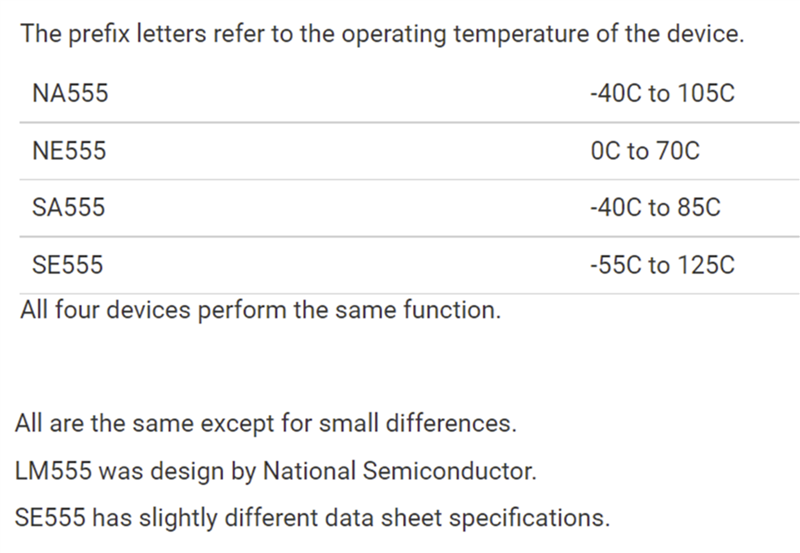
SA, NA, NE, SE prefixes are all the same except small differences listed in the product datasheet specs. These devices have a very long history, close to 50 years. The biggest contributing factor is the changes in semiconductor industry filed over many decades. At one time, 0C to 70C was standard. All four prefixes survived all of this. The TLC555 is a CMOS device and was created in 1983. Because of the higher input impedance of the TLC555 over that of the NE555 and other prefixes; the TLC555 can use smaller timing capacitor values.
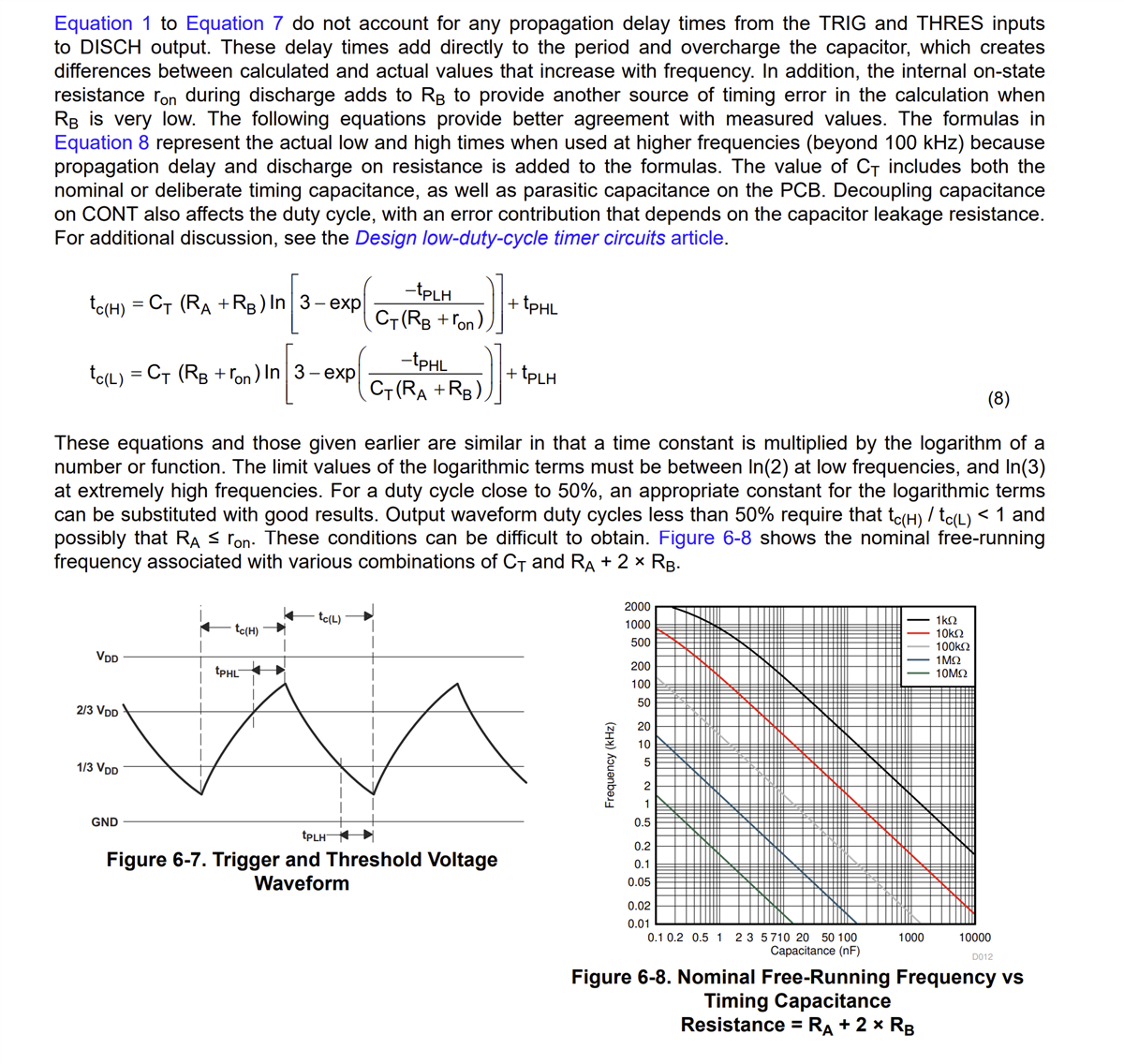
The SA555 has more output current drive capability at up to 200mA where the TLC555 has up to 100mA. The TLC555 is the only datasheet that provides guidance for operating frequencies above 100kHz.
The most modern timer is the TLC3555 and is the fastest timer out. This device was just released and can be found below.
Thansk for your answer, I have almost everything clear, just a last clarification. But when you say: "Because of the higher input impedance of the TLC555 over that of the NE555 and other prefixes; the TLC555 can use smaller timing capacitor values." You mean that with TLC555, we can achive higher output frequencies, right?
I mean, for the same desired output frequency (when it is a low frequency of course), the required value of CT (and RA & RB) would be the same for AS555 and TLC555. Is it right?
Yes for 100kHz and below the timers and their equations line up with each other. Variations around the nominal frequency will depend on the timer specifications such as threshold and trigger voltages however the biggest error source comes from the external R's and C for setting the timing. The TLC555 can have smaller timing capacitors and therefore a higher frequency. Above 100kHz of operation propagation delays start to impact the timing and for this reason the other equations above are used for operating 100kHz and greater in frequency.