This thread has been locked.

If you have a related question, please click the "Ask a related question" button in the top right corner. The newly created question will be automatically linked to this question.

LMX2571: LMX2571

Part Number: LMX2571
Other Parts Discussed in Thread: PLLATINUMSIM-SW

hi,

Now I am trying to design a 1W transmitter for our customer with your smart IC—LMX2571; 49channels with carrier range from 72.08MHz—72.98MHz, the carrier pitch is 20KHz;

We take the advantage of the Direct Digital FSK Modulation of your Smart IC, FD=+1.8KHz ----1

FD=-1.8KHz ----0

Here is the blockdiagram, and the some configuration of Synthesizer Duplex Mode;

cid:image001.png
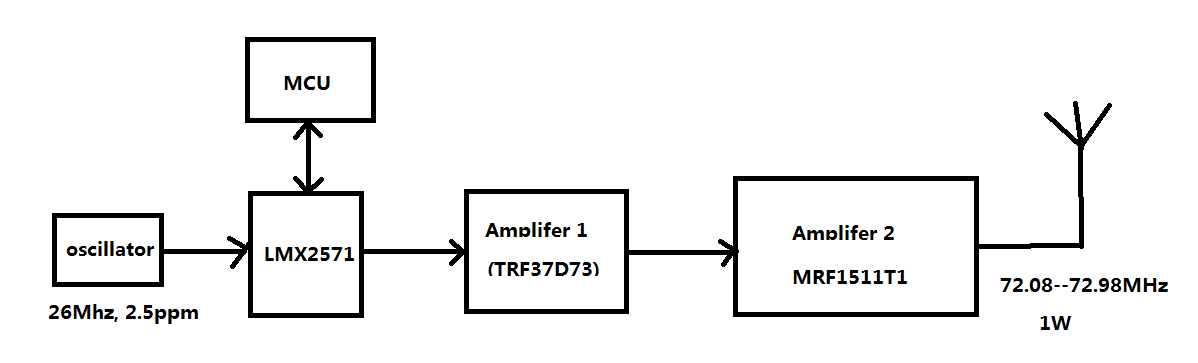
 cid:image002.png

The circuit of LMX2571 is as Picture1 in attached picture(open it with paint), any problem or suggestions?
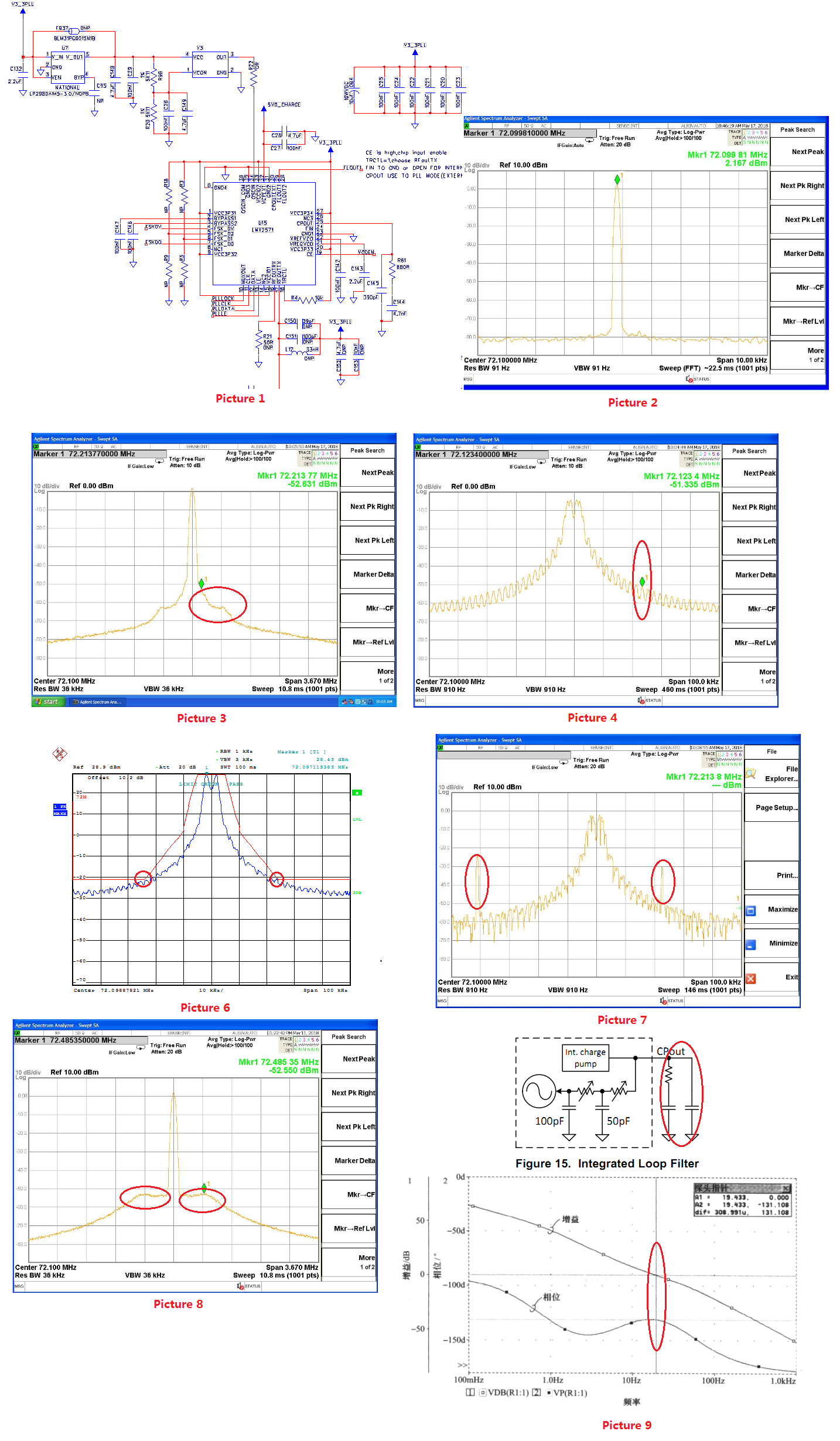
When we disable the FSK, with setting FSK_EN_F1, FSK_EN_F2 to 0, the output frequency spectrum(between Amplifier 2 and Antenna) is very good(Picture2 in attachments, span is just 10k), so when LMX2571 close its FSK function, the output frequency spectrum is very good;

When we enable the FSK, with setting FSK_EN_F1 =1, FSK_EN_F2= 1( and setting LF_R3/R4_F2/F1=1, CP_IUP/IDN=1;) the output frequency spectrum(between Amplifier 2 and Antenna) is as picture3,4(span is 3.67MhZ and 100k), much worse than picture2; Furthermore it can’t pass conductive bandside test of FCC part90, as picture6, 

So we have to optimize bandside , with setting LF_R3/R4_F2/F1=0, CP_IUP/IDN=16, (and with setting FSK_EN_F1 =1, FSK_EN_F2= 1), now the bandside just improve a little(2DB margin), but phase noise deteriorated(picture8), can’t find a balance..

And we did try to use some more stable oscillator, unluckly no any improve;

From above description, we can get that how much/greatly The FSK modulation affect/effect the bandside noise;

We guess that maybe revising some FSK modulation parameters can fix this problem, --getting both phase noise and bandside well; but we don’t know how to do it;

So could you do me a favor to offer some suggestions about revising some FSK modulation parameters to fix this problem??

By the way, when we set LF_R3/R4_F2/F1=1, CP_IUP/IDN=1; there are some spur in the frequency spectrum(Picture7), we guess the parameters of LPF was not the best,

as we know, the best situation of PLL is the phase margin at the point of loop bandwidth is about 40-50 degree( as picture9), but how to estimate the value of resister and capacitor in LPF(figure15 in picture9) to get the best phase margin at the right frequency(loop bandwidth)? Do you have any suggestions? Or any paperwork? Or is there any software tool for it ?

  • Dear Eric,

    thank you for reaching out.

    great questions. There are a number of things to do to improve your use case.

    Are you using the device with a certain amount of oversampling meaning you send more than just the FSK bit?

    in figure 6 it sounds like you may not have any pulse shaping?

    In figure 8, you may need some oversampling .

    I have assigned an engineer very familiar with FSK modulation on this device.

    thank you for your patience.

    Regards, Simon.
  • hi Simon,

    1. Are you using the device with a certain amount of oversampling meaning you send more than just the FSK bit?
    we use 2FSK to modulate the carrier, geting the carrier shift +-1.8k;
    FD=+1.8KHz ----1
    FD=-1.8KHz ----0
    I don't understand "what is a certain amount of oversampling meaning you send more than just the FSK bit", could you descripe it more detailed with some picture,? or tell me where i can read it in datasheet ?

    2.in figure 6 it sounds like you may not have any pulse shaping?
    what is the "pulse shaping"? could you do me a favor to tell me where i can get it from the datasheet ;
    3. In figure 8, you may need some oversampling .
    where i can get it from the datasheet?

    Regards,
    Eric
  • Hi Eric,

    If you are doing simply FSK (without pulse-shaping), the modulated bandwidth is going to be very wide.
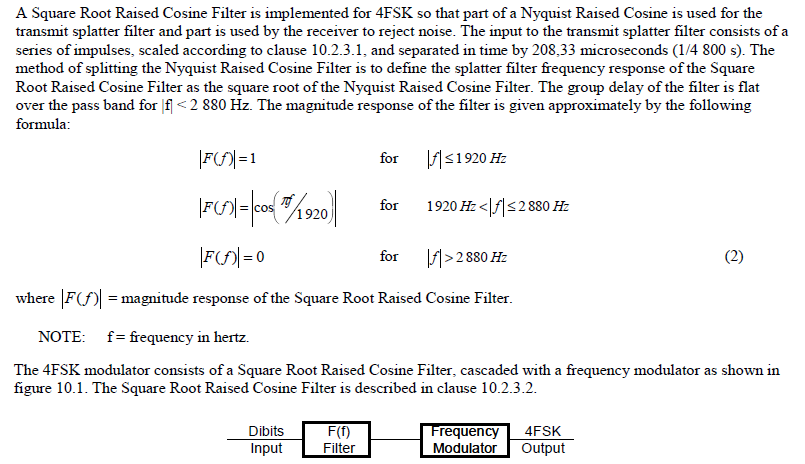
    For bandwidth limited applications, we should shape the FSK signal with some sort of pulse shaping filter, such as Gaussian filter or Root Raised Cosine filter.
    To implement filter, we will need oversampling. Please refer to appnote SNAA309 for details.

    Pluse-shaped FSK requires some MCU processing resource and more design effort. A simply way to improve the modulated bandwidth is to reduce the loop bandwidth. Drawbacks of this method are: the efficiency is not high and the modulated data will be distorted.

    So if you want a small effort to pass the radio standard requirement, change the loop bandwidth. If you understand the theory of oversampling and are able to implement the MCU code, then do pulse-shaping FSK.
  • Eric,

    Let us know if you need help with LMX2571. The app note should be a great reference to work with.

    Regards, Simon.
  • hi,

    I've read through the appnote"SNAA309", But I am still confused......
    Our application is very simple, we just use discrete 2FSK, the frequency deviation is +1.8k and -1.8k;
    +1.8k == bit"1";
    -1.8k == bit"0";
    for instance: if we want to transmitter"0xB5=10111001"; frequency deviation sequency would be" +1.8k -1.8k +1.8k +1.8k +1.8k -1.8k -1.8k +1.8k "
    how can we use Over-sample/pulse-shaple for this kind of application?

    Regards,
    Eric.
  • Dear Eric,

    modulating the  carrier fequency with square wave increases the required BW from first principle. Pulse shaping such as guassian or raised cosine are used to reduce the required BW while providing a clean symbol at the sampling time. This apply to 2FSK or any FSK modulation.

    In order to be able to do pulse shaping, you will have to oversample (done by adding zeros between your symbol) your FSK stream, filter it and then send data to LMX2571.

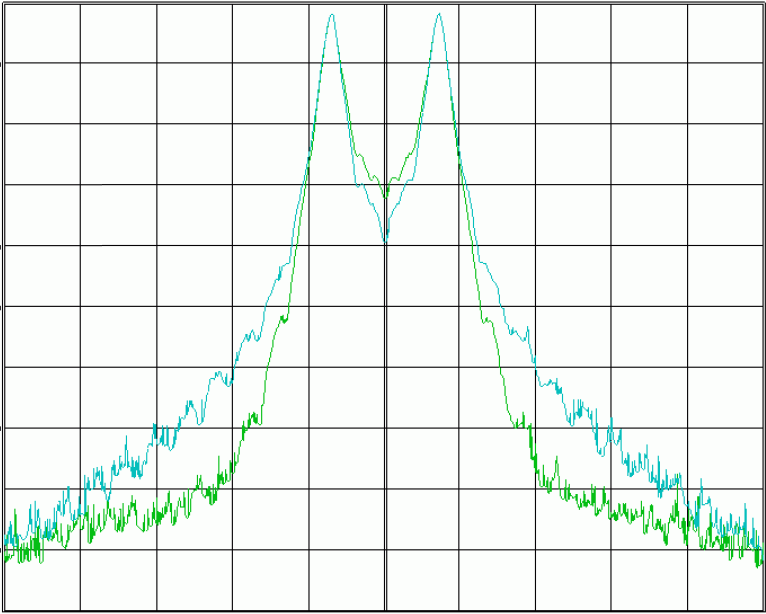
    The WORD document attached shows a plot a an FSK signal in blue and the pulse shaped version in green.

    I hope this helps,

    Regards, Simon.

    pulse_shaping.docx

  • hi,

    Than you again.

    such as:
    If the data I want to send now is the code stream: 0x123456789ABCDEF123456789ABCDEF...
    How to go over sampling such binary code stream?

    How to add guassian filtering to such a binary stream or turn it into raised cosine?

    If you add 0 to the binary stream and then filter, does the data change? Is it necessary to do corresponding processing on the receiver?

      
    Now take the code stream 0x123456789ABCDEF to be launched as an example.

      
    Could you draw a block diagram and add a text description?

    Regards,
    Eric
  • Hi Eric,

    The customer needs to implement a digital filter algorithm in their software to "filter" and construct the filtered waveform. 

    Here is an example filter as described in ETSI specification.

    here is modulated spectrum comparison between no filtering and Gaussian filtering.

    My advice is, if the customer understands the need of pulse-shaping filter and is able to implement the filter in their system, go ahead to implement the filter, they should be able to get a much better modulated spectrum without scarifying signal integrity.  

    However, if the customer cannot implement the filter, then tweak the loop bandwidth to make the modulated spectrum smaller.

  • hi,

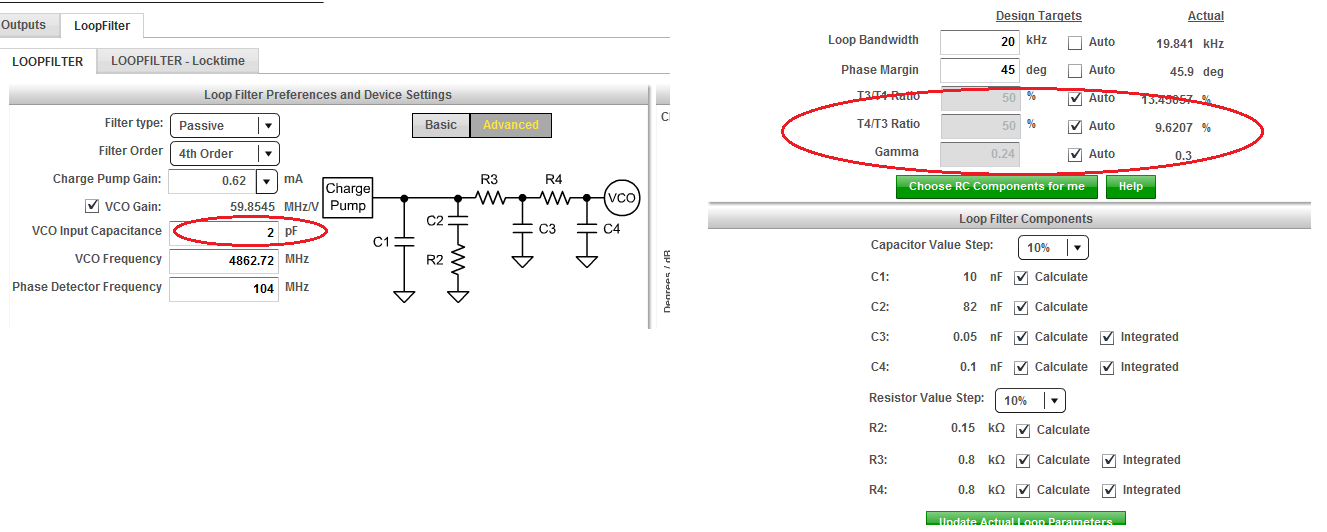
    As shown below:

              I did some simulations using online tools. Here are a few questions:

          1): The VCO input capacitance of Lmx2571 cannot be found in the datasheet. What should be set?

           2):T3/T1 Ratio

                    T4/T3 Ratio

                     What do they represent? What is the best value range?

           3) What does Gamma stand for? What is the best value range?

    Regards,

    Eric

  • Hi Eric,

    I suggest you use PLLatinum Sim to do simulation. www.ti.com\tool\pllatinumsim-sw.
    Simulation tool will take care the value of VCO input capacitance. No need to change this value.
    There is no "the best value" in pll design because some parameters have conflicts to each other. If you make "the best" to one of the parameters, then another parameter may become "the worst". Details of pll design is available here: www.ti.com/.../snaa106
    if you do not have an idea how to set the parameters, simply type in the desired loop bandwidth, the simulation tool will do the rest for you.
  • hi,

    Thank your for your support and thanks for your so detailed explain;

           I'd tried to treak the loop bandwidth, yes, when I reduced the loop bandwidth, I definitely got the better sideband, but phase noise worsened;

           so we hope to get both sideband and phase noise well....

           Now I understand a little...

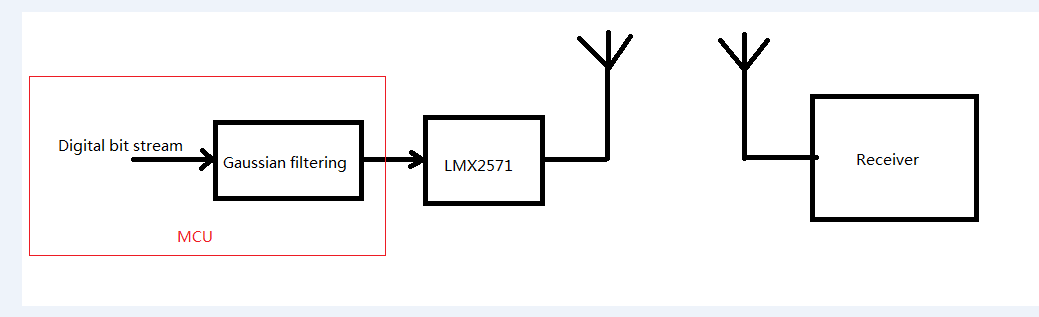
           As below picture, if we want to transmitt digital bit stream"0X48ED", for example, we just need to let it go through a filter , then feed them to LMX2571 for 2FSK modulation...?  right?

            and if we need to do something in receiver to recover the initial data?

           and if you have any example code for reference?

    Regards,

    Eric

  • Hi Eric,

    You also need oversampling.

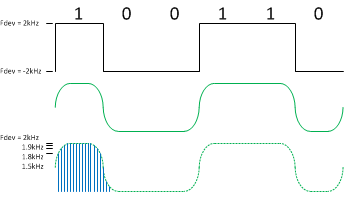
    suppose your bit stream is 100110......while "1" and "0" represent 2kHz and -2kHz frequency deviation. 

    If you modulate LMX2571 with this bit stream, then the output of LMX2571 will be fc+2kHz, fc-2kHz, fc-2kHz, fc+2kHz, fc+2kHz, fc-2kHz, ....

    The function of the filter is to avoid the sharp, big frequency change between fc-2kHz and fc+2kHz. 

    After the filter, the edges of bit transition are round-off. We therefore need a more faster sampling rate to construct the edges. 

    The new bit stream become fc+1.5kHz, fc+1.8kHz, fc+1.9kHz, fc+2kHz, fc+2kHz, ...., fc+2kHz, fc+1.9kHz, fc+1.8kHz, fc+1.5kHz, fc, fc-1.5kHz, fc-1.8kHz, .....

    At the receiver end, I think the regular FM demodulator is good enough, no additional block is necessary for Gaussian filter.