This thread has been locked.

If you have a related question, please click the "Ask a related question" button in the top right corner. The newly created question will be automatically linked to this question.

OPA2192: part selection

Part Number: OPA2192
Other Parts Discussed in Thread: AMC1311, , OPA192, PGA204, THS4551, THS4561

Dear Sir,

We are developing a reference energy meter using the ADE9430CPZ from Analog Devices, which supports differential input measurement.

Please note the following details of our design:

  • In the voltage measurement circuit, we are using a resistor divider network.

  • For isolation, we are using AMC1311 from Texas Instruments, which provides a differential output.

  • In the current measurement circuit, we are using a CT with burden resistor, followed by a gain stage using PGA204AU.

After the PGA204AU stage, we need to convert the single-ended signal to a differential signal compatible with the ADE9430 input.

We are considering the use of OPA2192 (Texas Instruments) for this purpose.

Kindly confirm whether OPA2192 is an appropriate choice for a precision reference meter application. If there are better alternatives for single-ended to differential conversion in this case, please advise.

We have ±15 V and +5 V supplies available in our design.

Additionally, we request you to kindly share any relevant application notes or reference designs for implementing single-ended to differential conversion using OPA2192.

Looking forward to your valuable guidance.

  • Janardan,

    The OPA192 will work.  See the document below for a potential implementation:

    https://www.ti.com/lit/an/sbaa265a/sbaa265a.pdf?ts=1772560379428

    You can also use a fully differential amplifier:

    https://www.ti.com/lit/an/sbaa246b/sbaa246b.pdf?ts=1772560032544

    https://www.ti.com/lit/an/sbaa264b/sbaa264b.pdf?ts=1772560055799

    Finally, there are some products that may help you to do it all with one device:

    https://www.ti.com/lit/ds/symlink/pga854.pdf

    https://www.ti.com/lit/ds/symlink/pga848.pdf

    https://www.ti.com/lit/ds/symlink/pga855.pdf

    I would start by looking at the PGA devices and see if any one of those works in place of the PGA204 + OPA192.  If not the opa192 or FDA option would work well.  Let us know if you have questions about the document. 

    Best regards, Art

  • Dear Sir,

    Thanks for providing your valuable suggestions.....

    now we are going for OPA2192IDR in our design.

    can you have applications note for OPA2192IDR to make single end to differential output so we can create the same.

  • Hello Janardan, 

    We have an application note for Single-Ended Input to Differential Output Circuit that can help guide you in your design. 

    https://www.ti.com/lit/an/sboa216b/sboa216b.pdf?ts=1772725669250&ref_url=https%253A%252F%252Fwww.google.com%252F

    Best Regards, 

    Chris Featherstone

  • Dear Sir,

    We have make schematicOPA2192IDR.pdf using OPA2192IDR using Single-Ended Input to Differential Output Circuit. can you check and guide us to correct the same. we are attaching for your reference.

  • Janardan,

    A few feedback points here -

    1) Why is there diodes clamping the PGA output to 3.3 V?  Is the PGA only supposed to output 3.3 V? 

    2) Both non-inverting inputs appear to be connected to each other with a 10 kOhm resistor, then the second is connected to 0.625 V directly.  This doesn't seem to align with the circuits provided in this post previously.

    If you can tell me what the PGA voltage range, and what the differential voltage range is coming out of the single-ended to differential converter, we can give you a circuit that will accomplish it.

    Regards,
    MIke

  • Dear Sir,

    Thank you for your reply.

    Regarding Point No. 1:
    Please note that in our previous design (old metering ICs Maxim) the PGA output was biased to 3.3 V, because our raw signal swing was referenced around 3.3 V and fed to the ADC input (single-ended ADC input of the metering IC).- sorry for confusion

    However, in the New design  (Metering ICs - ADE9430) with a differential output stage, we understand that it may not be necessary to bias the PGA output directly to 3.3 V, Kindly confirm if this understanding is correct.

    Regarding Point No. 2:

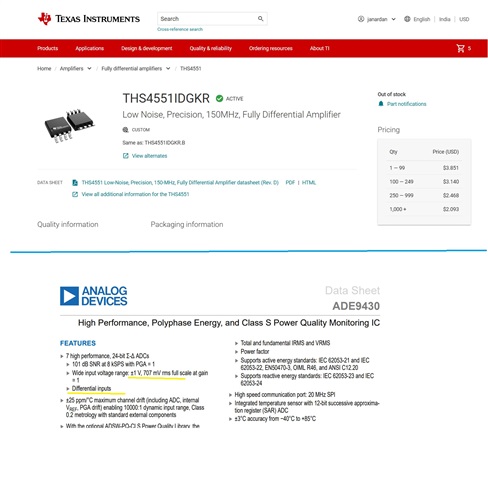
    Please note that our ICs (ADE9430) Wide input voltage range: ±1 V, 707 mV rms full scale at gain.


    We understand that the Texas Instruments THS4551 (precision fully differential amplifier) can provide better differential performance compared to the OPA2192, which is not a true differential ADC driver.

    However, we noticed that the THS4551 is currently difficult to source through the TI portal (often shown as out of stock). Therefore, could you please advise whether we should proceed with THS4551 or suggest another recommended alternative part with long-term availability?

    For reference, the THS4551 is designed to convert single-ended signals into differential outputs for precision ADC interfaces, offering low noise, low offset, and excellent performance for high-resolution ADC systems.

    Additionally, it would be very helpful if you could share an application note or reference design showing the recommended signal chain:

    PGA Output → Differential Driver → Metering IC (e.g., ADE series ADC input)

    This will help us ensure the correct interface architecture for our metering application.

  • Dear Sir,

    We have found that the IC - THS4551  is available at the distributor channel partners.

    https://www.digikey.in/en/products/detail/texas-instruments/THS4561IDGKR/11502203

    Based on the THS4551 datasheet, we have prepared a new schematic for your review and analysis.


    6215.Sheet1.pdf                                                                           

    ade9430.pdf

    Kindly review the attached schematic and let us know if any corrections or modifications are required.

    Best regards,
    Janardan

  • Hello,

    Ok - the FDA (THS4561) can work and is a good idea.  However, it appears the inputs of the competitor's device are bipolar, centered around GND.  This means the input voltages to that device need to go negative, which means the output of the FDA needs to go negative, which requires that the supply voltage of the FDA is negative also.

    Any input drive circuit will require that the supply voltage needs to be negative.  For the THS4551, it is a low-voltage part, so the supply voltage would need to be +2.5/-2.5 or lower.  You could use the THP210 and use wider supply voltages such as +5/-5.  Also, you will need to set the VOCM pin (pin 2) to ground; this determines the common-mode voltage at the output, which is usually the center of the ADC's input voltage range.

    Another option that would put the PGA and FDA all in one device is the PGA855; with this device, you can have a PGA along with differential output drive in a single package.  Take a look at that device and let me know if it is interesting, I can forward this post to the team that covers it.

    Regards,
    Mike

  • Dear Sir,

    Thank you for your reply.

    As per your suggestion, we have considered the part number THP210DR. In our circuit, we already have +15 V and −15 V DC supplies available, so we plan to operate the device with a dual supply configuration.

    In our metering IC, the reference voltage is 1.25 V. However, since we are using a rail-to-rail supply, we have connected pin no. 2 (GND) of the THP210DR to ground so that the signal is cantered around 0 V. so we understand that no need to connect vref 1.25V to pin no 2 (VOCM).

    We are using the PGA204AU because it provides selectable gains of 1, 10, 100, and 1000, which helps us amplify the very small CT output signal effectively.

    We have prepared the schematic with reference to the Texas Instruments THP210DR evaluation board.

    Please find the attached schematic along with the evaluation board schematic for your review. We would appreciate your valuable suggestions and feedback.

    Current Circuit.pdfTHP210 Evaluation Module User's Guide (Rev. A).pdf

  • Dear Sir,

    In line of above message additionally, we have one query: in the evaluation board schematic, some components are marked as DNP (Do Not Populate). Please advise whether these components are required in our design. If they are not mandatory, we plan to remove them from the schematic and PCB layout to save PCB area.

  • Hi Janardan, 

    We are going to need a couple of days to review the circuit. We will respond by the end of the week. 

    Best Regards, 

    Chris Featherstone

  • Hello,

    OK, overall looks good.  Here is my feedback for what is suggested to keep for a basic configuration. Our e2e system is currently broken so I cannot add a file or image so I will refer to reference designators in the first block:

    D35: This clamps to GND and V3p3, but the voltage you are looking for is bipolar around ground, so you don't want to clamp to GND.  Remove this.

    C66, C76, C72:  This are differential and common-mode filter capacitors that can help filter the input voltage.  If you don't have specific needs for input filtering or very low noise requirements then they can be deleted.

    R90, R96, R47, R92: For higher-level active filter designs, these resistors can be used, but for a basic design they are not necessary and can be deleted and the nodes shorted out.

    C73, C68, C74: These may or may not be necessary; for ADC drive, these components are usually necessary for a charge storage element.  I don't know for sure what the competitor's device will require here, so I suggest to keep the layout in place and you can modify according to performance when you measure the first board.

    R101: Not necessary if you are positive that the common-mode should be shorted to GND but it could be nice to have if this changes.

    Hopefully these help finalize your design.

    Regards,
    Mike

  • Dear Sir,

    Thanks for your reply....

    we will make the changes as per your suggestion and if any issue found ,I will revert you back.